

Copenhagen: Canals, Nordic Design & Standout Food
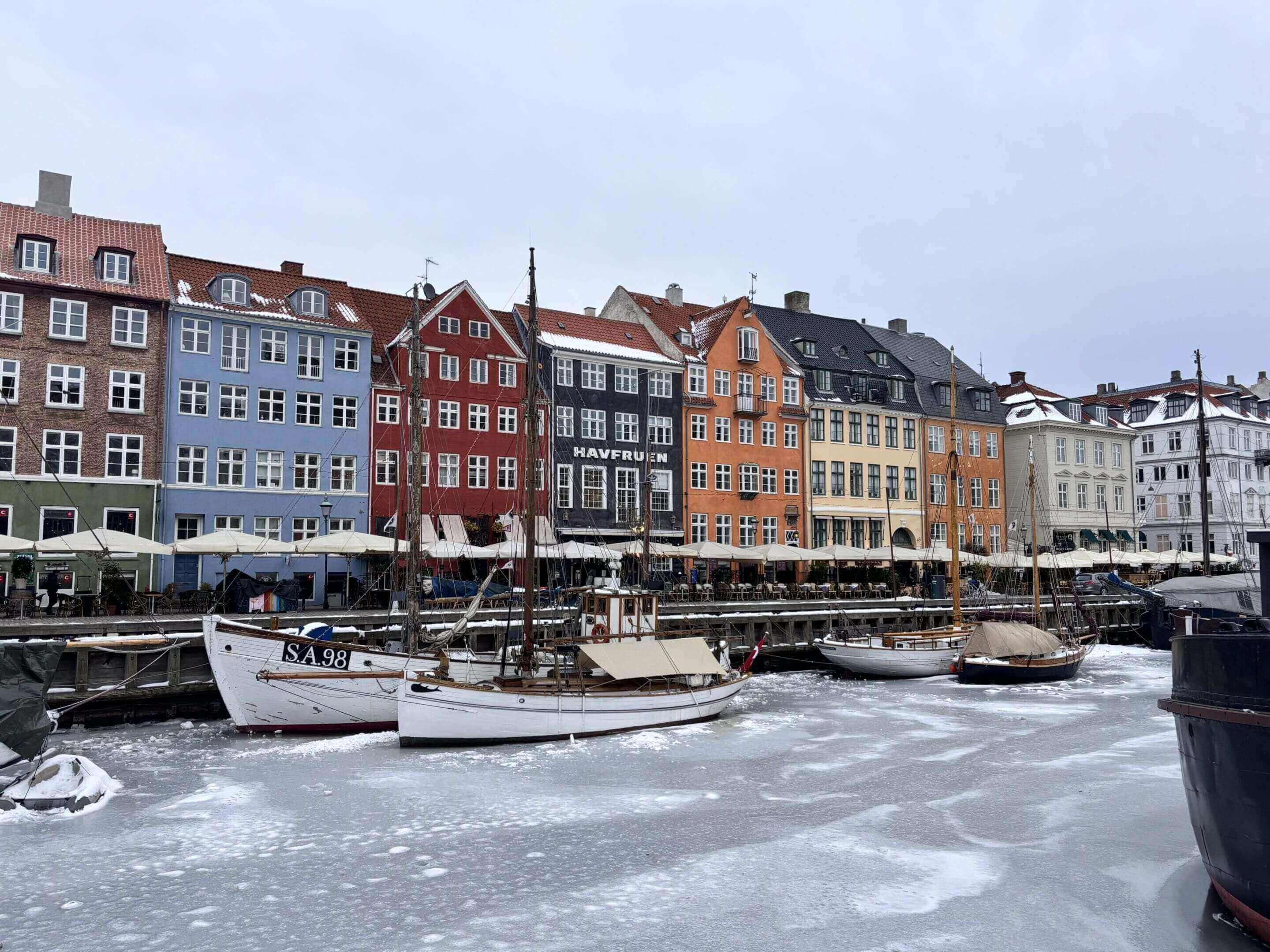
We arrived in Copenhagen in mid-February 2026 during one of the most significant cold spells Denmark had seen in over a decade.
According to the Danish Meteorological Institute (DMI), January 2026 was the coldest January in 16 years, with temperatures averaging 2.2°C below the 1991–2020 norm. In early February, snowfall reached 17 centimeters — the heaviest in Copenhagen in more than a decade — and temperatures dropped low enough to freeze canals across the city.
And yet, even in record cold, Copenhagen impressed us.
The design was intentional.
The food was exceptional.
The coffee culture became our refuge from the cold.
We were only there for 48 hours — but visiting during an unusually severe winter revealed a side of the city few travelers experience.
If this was the city at its most frozen, I can only imagine it in full bloom.
Copenhagen Travel Basics (Quick Guide)
If you’re planning a trip, here are a few practical things to know:
💳Currency: Danish Krone (DKK). A quick way to estimate: 10 DKK is roughly $1.50 USD, so prices are typically higher than they first appear. Credit cards are widely accepted, and many places are cashless though.
🏧Cash Tips: If you need cash, use ATMs from major banks once you arrive. Avoid airport exchanges and always choose to be charged in local currency (DKK) instead of USD to avoid poor conversion rates.
💳Payment & Tipping: Copenhagen is largely cashless, and service is already included in menu prices. Tipping isn’t expected, but if the experience stands out, rounding up or leaving around 5–10% is appreciated.
💸Is Copenhagen Expensive? Yes—especially for dining. That said, the quality of food, design, and overall experience often reflects the price.
🍽️Dining Culture: Meals are slower and more intentional. Reservations are often recommended, and you’ll typically need to ask for the check when you’re ready.
🗣️Language: Danish is the official language, but English is spoken almost everywhere.
🚲Getting Around: Copenhagen is easy to explore on foot or by bike, and public transportation is clean and efficient.
💳Bike Culture: Bikes are part of daily life. Pay attention to bike lanes—they move fast and are taken seriously.
🌦️Weather: Conditions can impact your plans more than expected, especially in winter, so flexibility helps.
❄️Winter (Dec–Feb): 30s–40s°F, higher chance of wind, rain, or snow
🌸Spring (Mar–May): 40s–60s°F, mixed weather, gradually warming
☀️Summer (Jun–Aug): 60s–70s°F, long days, most active season
🍁Fall (Sep–Nov): 40s–60s°F, cooler with increasing rain
🗨️A Few Words to Know:
Hello – Hej - pronounced “hi”
Thank you – Tak - pronounced “tahk”
Cheers – Skål - pronounced “skoal”
Table of contents
- Is Copenhagen Worth Visiting in Winter?
- What to Expect in Copenhagen in Winter
- Where We Stayed in Copenhagen
- Where We Ate in Copenhagen
- Danish Pastries in Copenhagen
- Coffee Culture in Copenhagen
- Copenhagen Landmarks, Architecture & Frozen Canals
- Thomas Dambo Trolls
- Getting Around Copenhagen in Winter
- Copenhagen Neighborhoods We Explored
- What We’d Do Differently (And Why We’re Going Back)
- Final Thoughts on Visiting Copenhagen in Winter
Is Copenhagen Worth Visiting in Winter?
If you're wondering whether Copenhagen is worth visiting in winter, the short answer is yes — with a few caveats.
Winter transforms the rhythm of the city. The canals may freeze. Tivoli may be closed. Wind can dictate your pace. However, the tradeoff is fewer crowds, dramatic light, cozy cafés, and a more contemplative version of Copenhagen that feels deeply local.
If you prioritize food, design, and walkability, winter can absolutely work — especially for a focused 48-hour stay.
What to Expect in Copenhagen in Winter
January 2026 was officially recorded as Denmark’s coldest January in 16 years. Early February snowfall reached 17 centimeters — the second-deepest snow cover in Copenhagen since 2011 — and temperatures in parts of Denmark dropped as low as -18.8°C.
Freezing canals are not typical in modern Copenhagen winters. Seeing them solidified just how unusual this stretch of weather truly was.
Frozen Canals & a Quieter Harbor
Nyhavn was visually stunning, but completely still. The water was frozen. No boats moved. The absence of motion made it feel almost cinematic — peaceful, photogenic, and suspended in time.
It wasn’t disappointing. Just different.
Wind Is the Real Factor
The temperature alone didn’t tell the whole story. Wind coming off the harbor made it feel significantly colder — especially in open squares like Amalienborg Palace, where the gusts nearly knocked me down during the changing of the guard.
A More Subdued Energy
Even locals mentioned the city didn’t feel as lively as it typically does.
Tivoli Gardens was closed. Harbor life was paused. The canals were frozen. Outdoor seating areas were largely empty — not because they didn’t exist, but because the wind made lingering difficult.
And yet, outdoor dining wasn’t entirely gone.
Take Gasoline Grill, for example. The original location only has outdoor tables — and yes, we sat at one. Luckily it was tucked beside the building, which blocked some of the wind. Even so, the parking lot was icy enough that I briefly saw my life flash before my eyes walking to our table.
It was cold. It was slippery. And it was definitely memorable.
Winter doesn’t shut Copenhagen down — it simply changes the rhythm of the city.
Interiors Shine
Winter pushes you inside — and Copenhagen does interiors beautifully. Warm lighting, thoughtful Scandinavian design, incredible bread and coffee.
Hygge isn’t a cliché here. It’s survival strategy.
Hygge (pronounced hoo-gah) is a Danish concept that blends coziness, warmth, comfort, and togetherness — especially intentional during long winters. Think warm light, good conversation, slow moments, simple pleasures.
Where We Stayed in Copenhagen
We stayed at Hotel Admiral, and I would absolutely choose it again.
Housed in an 18th-century maritime warehouse on the waterfront near Nyhavn, Hotel Admiral blends historic structure with understated Scandinavian design. Exposed timber beams stretch across the ceilings, large harbor-facing windows bring in soft Nordic light, and the overall aesthetic feels grounded rather than polished to perfection.
It has character — real character — not manufactured charm.
Why We Loved It
For a short winter stay, location was everything.
The hotel sits directly on the harbor, across from the Copenhagen Opera House, and within easy walking distance of Amalienborg Palace, the Marble Church, and Nyhavn. We were essentially in a compact loop of major landmarks, which made exploring manageable — even in extreme cold.
In February, minimizing transit matters. Being able to step outside and reach multiple sights within minutes made the city feel accessible rather than overwhelming.
Amenities Worth Noting:
Hotel Admiral balances history with modern comfort.
- Restaurant aye aye offers Mediterranean/Nordic cuisine in a warm, wood-forward setting — especially inviting in winter.
- A sauna, steam room, and massage services provide a genuine cold-weather reset.
- A 24-hour fitness center and strong Wi-Fi make it practical for longer stays.
- Bike rentals and electric boat tours reflect Copenhagen’s outdoor culture (in warmer months).
- Paid private parking is available for those driving.
- The property also includes modernized meeting and event space, making it appealing for small group stays or retreats.
While it isn’t flashy luxury, it feels distinctly Copenhagen — historic, well-located, and quietly confident.
Who It’s Best For
- First-time visitors
- Travelers who value atmosphere and history
- Anyone wanting to stay central and minimize transit
Large harbor-facing windows and exposed timber beams made the interior feel atmospheric. It’s historic, understated, and distinctly Copenhagen.
Where We Ate in Copenhagen
If there was one category where Copenhagen completely surprised us, it was food.
Copenhagen felt vibrant, creative, and deeply intentional — even in the dead of winter.
For me, cities reveal themselves through their kitchens as much as their culture and landmarks — and Copenhagen delivers.
Our First Meal Was at a Gas Station
I truly couldn’t believe my husband was taking me to a gas station for our first meal in Copenhagen.
But this wasn’t just any gas station — it was the original Gasoline Grill, a Copenhagen institution known for some of the city’s best burgers.
After flying in from Finland, layered up against record-breaking cold, this was not the chic Nordic welcome I had imagined.
We ordered “The Benchmark” cheeseburger and made it a double, with organic fries finished in truffle salt — intentionally pacing ourselves because we knew we had a full day of eating ahead.
Burgers are one of my go-to comfort foods, and this one absolutely delivered. Juicy, balanced, indulgent in the best way.
It was casual, unpretentious, and unexpectedly excellent.
And honestly? It set the tone. Copenhagen takes food seriously — even at a gas station.
There’s something noticeably different about ingredients in Europe — cleaner, more tightly regulated, more transparent. Even a burger tastes layered rather than heavy.
(We did try the airport location on departure day, and let’s just say I’m glad the original was our first impression.)
Torvehallerne Market (Food Culture Hub)
Torvehallerne is Copenhagen’s modern glass-covered food market, located near Nørreport Station.
From the outside, it may not rival some of the grand historic markets you’ll find in other European cities. But step inside, and the depth is impressive.
The variety, quality, and sheer number of vendors felt elevated. It wasn’t just snacks — it was serious food.
We visited multiple vendors inside:
Hija de Sanchez
Founded by former Noma pastry chef Rosio Sánchez, this spot brings authentic Mexican street food into Copenhagen in a way that feels both unexpected and completely at home.
We ordered the taco combo (al pastor, barbacoa, and seasonal vegetables) along with guacamole, salsa, and chips, splitting everything as we made our way through the market.
The flavors were vibrant and layered, and even as someone who doesn’t usually gravitate toward corn tortillas, these stood out—softer and more flavorful than expected.
Slagter Lund
A traditional Danish butcher that feels grounded and authentic—more old-school craftsmanship than modern reinvention.
We tried their fried pork sandwich (flæskesteg), drawn in by the crispy pork and classic preparation.
The crunch was incredible, the flavor rich and satisfying, and the bread tied it all together. Simple, traditional, and done exceptionally well.
Collective Coffee
A well-known Copenhagen coffee roaster with a clean, design-forward space that feels very on brand for the city.
We stopped here for a quick reset in the middle of exploring the market—I had a latte and he went with an Americano.
Both were smooth, well-balanced, and thoughtfully made, and it stood out as one of the better coffee stops we had in Copenhagen.
Xocolatl
A Danish chocolatier inside Torvehallerne that offers a beautiful mix of filled chocolates and specialty creations.
We picked a mix of their filled chocolates along with the alcohol-infused “Tipsy Frogs,” which made it easy to try a variety without committing to a full box.
Rich, creative, and indulgent—this was an easy stop for something sweet in between all the savory bites.
Torvehallerne felt like a microcosm of Copenhagen—modern, curated, and deeply intentional.
Having visited food markets across Europe, this one stood out. While it may not have the historic charm of some markets in Portugal or Spain, the overall quality here felt noticeably more elevated.
Kodbyens Fiskebar
A seafood-focused restaurant in Copenhagen’s Meatpacking District that blends industrial surroundings with a refined, modern menu.
This was our dinner reservation after spending the day eating our way through Torvehallerne, and it felt like the perfect transition into a more elevated experience.
Fresh, thoughtfully prepared seafood in a setting that felt both relaxed and intentionally designed. It’s a reminder that Copenhagen’s food scene doesn’t slow down—it stays consistently high-quality and worth planning around.
Selma
A modern take on traditional Danish smørrebrød, blending classic foundations with a more refined, contemporary approach.
Selma takes smørrebrød to a whole different level. It felt very chef-driven—unexpected, a little different, but really well done.
It’s the kind of place that gives you a true taste of Danish food culture, just with a more elevated twist.
Marv & Ben (Standout Meal)
A Michelin-recognized restaurant in Copenhagen known for its refined take on New Nordic cuisine, with a strong emphasis on seasonal ingredients and thoughtful presentation.
We opted for the tasting menu with juice pairings, and each course felt thoughtful and seasonal.
We’d never done a juice-paired tasting menu before—it’s usually wine or cocktails—but here, the juices felt just as intentional as the food. Layered, balanced, and designed to complement each course, they reflected the New Nordic focus on local, seasonal ingredients, fermentation, and botanical complexity.
One dish—the fallow deer tartare—came with a story. We were told it had been sourced from a royal hunt, reportedly shot by the king, adding a layer of tradition and provenance to the experience.
That combination of hyper-local sourcing, storytelling, and precision made the meal feel uniquely Danish.
This is the kind of restaurant that makes you understand why Copenhagen is such a respected food city.
A Stop at Noma
Even though Noma was closed, walking past it still felt necessary.
Often credited as one of the most influential restaurants in modern culinary history, Noma helped define the New Nordic movement and reshape how people think about food.
The restaurant has since gone through significant changes, including leadership shifts and evolving plans for its future—adding another layer to its already complex legacy.
For anyone who follows food, it’s an institution. Standing outside, even briefly, felt less like missing a reservation and more like standing in front of a defining chapter of contemporary culinary history.
Food ended up being one of the highlights of this trip—and one of the reasons we’d go back.
Simple food, done well, rooted in place and story.
Danish Pastries in Copenhagen
Before arriving in Copenhagen, I had heard endlessly about cardamom buns—but Denmark’s true classic is wienerbrød, a flaky, buttery pastry rooted in Austrian technique and adapted into something distinctly Danish.
We made a point to try a few of the city’s standout bakeries, each offering a different perspective on tradition and modern execution.
Hart Bakery felt precise and architectural, with more restrained, laminated pastries and a quieter, design-forward atmosphere.
Juno the Bakery leaned more energetic and neighborhood-driven, known for its bold, cardamom-forward buns and constant movement behind the counter.
Andersen & Maillard struck the best balance for us—refined, thoughtful, and cohesive across both pastries and coffee.
Copenhagen approaches even something as simple as pastry with intention—rooted in tradition, but constantly evolving.
Today, fastelavnsboller appear across Copenhagen in February — some traditional, some wildly modern. They can be soft buns filled with whipped cream and custard, laminated pastry reinterpretations, or layered hybrids that blur the line between old and new.
They’re seasonal. Limited. And very worth seeking out.
Fastelavnsboller typically begin appearing in late January, with peak selection in the weeks leading up to Fastelavn Sunday.
One practical note for winter travelers: at the locations we visited, only Hart Bakery offered dependable indoor seating. Juno had outdoor tables (which were layered in snow and ice during our visit), and the Andersen & Maillard location we stopped at (Ny Østergade 15) leaned primarily takeaway — though the brand does operate other seating-friendly cafés.
In February, that distinction matters.
Coffee Culture in Copenhagen
Winter pushes you inside—and Copenhagen does interiors exceptionally well.
Coffee here isn’t rushed. It’s intentional. Even on the coldest days, cafés feel like an extension of the city’s design sensibility: thoughtful lighting, natural materials, and spaces that make you want to stay a little longer.
We found ourselves stopping for coffee as much for warmth as for caffeine.
Collective Coffee was our favorite overall. My latte and my husband’s Americano were both smooth and balanced—the kind of coffee that doesn’t need embellishment. The space felt clean and focused, serious about sourcing without feeling pretentious.
Prolog Coffee felt understated and design-forward—simple, minimal, and confident without trying too hard.
Kultur Caféen Christiania was the most visually stimulating of the three. Mismatched furniture, art-covered walls, layers of texture and color—we spent as much time looking around as we did sipping our drinks. It felt creative and slightly chaotic in the best way, a contrast to Copenhagen’s otherwise polished aesthetic.
And while not traditional cafés, both Hart Bakery and Andersen & Maillard delivered excellent espresso alongside their pastries. In Copenhagen, good coffee doesn’t feel like a bonus—it feels expected.
We didn’t have a single disappointing cup—which says something about the city’s standards.
In winter especially, coffee isn’t just a stop in your day. It becomes part of how you move through it.
In Copenhagen, good coffee doesn’t feel like a bonus—it feels expected.
Copenhagen Landmarks, Architecture & Frozen Canals
Even during one of the coldest stretches Copenhagen had experienced in over a decade — with frozen canals and record snowfall — the city was striking.
Winter sharpened the lines of its architecture. Snow softened the edges. And the absence of boat traffic made the harbor feel unusually still.
Nyhavn
We walked to Nyhavn expecting the iconic, colorful waterfront scene — and visually, it delivered.
Dating back to the 17th century, Nyhavn was once a busy commercial port. Today, it’s one of Copenhagen’s most photographed streets — and even more charming knowing that Hans Christian Andersen lived here for nearly 20 years.
The canal was frozen during our visit. No boats moved. No wake rippled against the historic facades.
The absence of movement made it quieter, more reflective. Peaceful. Photogenic in a different way than summer — less lively, more cinematic.
It wasn’t disappointing. Just different.
And that difference made it memorable.
Copenhagen Opera House
Directly across the harbor from Hotel Admiral stands the Copenhagen Opera House — one of the most modern architectural additions to the city.
Completed in 2004 and funded by Danish shipping magnate Mærsk Mc-Kinney Møller, it was gifted to the Danish state. The project sparked political debate over its scale, cost, and the extent of influence retained by its patron.
Today, it stands as a bold counterpoint to Copenhagen’s historic skyline — glass, steel, and precision rising across from centuries-old warehouses.
In winter, its sharp geometry feels even more dramatic against pale skies and frozen water.
Amalienborg Palace & The Changing of the Guard
Amalienborg sits at the center of Frederiksstaden and serves as the official residence of the Danish royal family. Four identical Rococo palaces frame an elegant octagonal square, creating a symmetry that feels deliberate and composed.
We hadn’t planned our timing, but as we turned into the square, we noticed guards moving across the icy stone, shifting posts in a quiet, disciplined rotation.
It wasn’t the full ceremonial Changing of the Guard — the larger midday procession that marches from Rosenborg Barracks with a band when the monarch is in residence. That version is more comparable to Buckingham Palace: formal, coordinated, and designed to draw a crowd.
What we witnessed was subtler.
Guards moved between positions with precision, their red and navy uniforms standing out against the pale winter light. The square felt expansive and exposed — and in February, the wind owns that space.
Twice, while trying to take photos, I nearly lost my footing. The gusts were strong enough that I eventually retreated around the corner closest to the Marble Church while my husband stayed to finish filming.
There were no drums. No spectacle.
Just structure. Discipline. And guards unfazed by weather most visitors would complain about.
In some ways, the quieter version felt fitting for winter — less pageantry, more presence.
The Marble Church
Just steps from Amalienborg rises the Marble Church, formally known as Frederik’s Church.
Its dome — one of the largest in Scandinavia — anchors the skyline of Frederiksstaden. From a distance, it feels grand but restrained, rising quietly rather than dramatically.
Up close in winter, the pale stone nearly blends into the muted February sky. The open square surrounding it gives the building room to breathe, and in the cold air, its symmetry feels even sharper.
Stepping inside shifts the experience entirely.
Where the exterior feels measured and architectural, the interior opens upward in soft curves and filtered light. The circular design naturally pulls your gaze toward the dome. Then, almost unexpectedly, you notice the towering pipe organs — intricate, imposing, and far more dramatic than the understated exterior suggests.
There’s a stillness inside that feels amplified in winter. Footsteps echo more noticeably. Conversations soften. The warmth of the space contrasts sharply with the wind outside.
It’s the kind of place that invites you to pause longer than you planned.
The Round Tower
The Round Tower’s 17th-century spiral ramp leads to panoramic city views without traditional stairs — a clever architectural solution that once allowed horses to transport equipment and supplies to the top.
Climbing the gradual curve feels different from ascending steps. There’s no rush, no abrupt pause — just a steady winding path upward.
At the top, Copenhagen stretches outward in muted tones. Copper rooftops, church spires, and — during our visit — waterways edged with ice. Winter light softened the skyline, giving the view a quiet clarity rather than dramatic contrast.
It’s less about height and more about perspective.
Church of Our Saviour (Admiring the Spiral Spire)
One of the most striking architectural moments in Christianhavn was the Church of Our Saviour, known for its exterior spiral staircase that wraps around the spire.
Added in 1752, the staircase includes more than 400 steps when open. It wasn’t accessible during our winter visit, but even admired from below, the dark twisting spire felt bold and sculptural against the sky.
In warmer months, visitors can climb the outside steps all the way to the top.
Even without climbing it, the design is dramatic. The dark spire twists upward against the pale winter sky, and the gold details catch whatever light February allows.
It felt bold. Sculptural. Almost theatrical.
Winter limited access — but it didn’t limit impact.
The Little Mermaid
We also made the walk to see The Little Mermaid, Copenhagen’s most famous — and perhaps most misunderstood — landmark.
Installed in 1913 and inspired by Hans Christian Andersen’s fairy tale, the bronze statue sits quietly along the harbor. And quietly is the right word.
Our taxi driver smiled when we mentioned we were going to see it.
“Most people start looking up as they get closer,” he said, “like it’s going to be huge.”
It isn’t.
The Little Mermaid is modest in scale — intentionally so. She sits just over four feet tall, perched on a rock, almost blending into the harbor around her.
In winter, with icy water behind her and fewer crowds lingering, she felt contemplative rather than touristy.
If you go expecting grandeur, you might be surprised.
If you go expecting symbolism, she delivers.
And honestly? I liked that she wasn’t oversized. It felt very Danish — understated, restrained, and quietly meaningful.
Kastellet
Just beyond The Little Mermaid sits Kastellet, one of Europe’s best-preserved star fortresses.
Built in the 17th century, its distinctive pentagram layout was designed for military defense — the angled bastions allowed for strategic crossfire and improved protection. From above, the structure forms a near-perfect star.
Walking its perimeter in winter felt peaceful rather than imposing. Snow traced the sharp geometric lines of the fortress, softening what was once a defensive stronghold into something almost serene.
It’s still an active military site today, which makes it feel more like a living landmark than a relic.
If you visit The Little Mermaid, don’t skip Kastellet. It’s arguably the more architecturally impressive stop.
Thomas Dambo Trolls
We set out to see two of Thomas Dambo’s wooden trolls during our short stay.
The first — located in Christianhavn — felt almost surreal against its surroundings. The area had a slightly bright, almost trippy energy to it, which made the oversized reclaimed-wood figure feel even more whimsical. In a city known for clean lines, muted tones, and intentional design, the troll was a playful disruption.
It felt like Copenhagen showing a different side of itself.
In the winter quiet, discovering it felt like finding something slightly secret — unexpected and charming.
The second troll, near the cruise terminal, proved more complicated.
An Uber driver attempted to take us there, but construction in the area made access confusing. It appeared to be behind fencing, and we couldn’t find a clear path to reach it. Later, I read that it was technically still accessible despite construction — but in real time, in freezing temperatures, it wasn’t straightforward.
It was disappointing — not because the troll wasn’t worth it, but because winter logistics can add friction, especially in areas under development.
If you’re visiting during colder months, I’d recommend double-checking current access conditions before heading out.
Getting Around Copenhagen in Winter
Despite record-breaking cold, Copenhagen was incredibly walkable — especially from Hotel Admiral.
We walked almost everywhere:
- Nyhavn
- Amalienborg Palace
- Marble Church
- Round Tower
- Christianhavn
The cold slowed us down, but it didn’t stop us.
What was wild to see, though, was how little it slowed locals down.
Even with frozen canals and biting wind, Copenhageners were still biking — like it was any other week of the year. Thick gloves, bundled scarves, steady pace. No drama. Just normal life continuing.
It was a reminder that biking here isn’t recreational — it’s infrastructure. It’s culture.
We didn’t attempt it in those conditions. Between wind and ice, it felt more like a test of resilience than sightseeing. But watching locals navigate it so effortlessly made us want to experience the city properly — on two wheels — in a warmer season.
We didn’t use public transportation, though it’s known to be efficient and easy. Instead, we relied on walking and a few Uber/Bolt rides when distances stretched or wind became too intense.
Watching locals bike through freezing temperatures was wild — and impressive. Here, biking isn’t recreational. It’s infrastructure.
For a short winter stay, staying central made all the difference.
Copenhagen Neighborhoods We Explored
One of the advantages of staying at Hotel Admiral was how much of Copenhagen we were able to explore on foot. In just 48 hours, we moved through historic royal districts, modern food hubs, canal-lined residential streets, and even one of Europe’s most unconventional communities.
Here’s a look at the neighborhoods that shaped our experience.
Indre By (City Center)
Indre By is the historic heart of Copenhagen — where narrow cobblestone streets weave between government buildings, retail corridors, and colorful facades that feel distinctly European.
Architecturally, this is where Danish Baroque and Neoclassical influences are most visible. Copper spires punctuate the skyline, and the scale feels intimate rather than grand. Even in winter, when light is softer and streets are slick with ice, the area retains a quiet elegance.
Most of the city’s major landmarks are within walking distance here, which makes it especially convenient for a short stay.
Nyhavn
Nyhavn dates back to the 17th century, originally serving as a busy commercial harbor. Today, it’s one of Copenhagen’s most photographed stretches — rows of brightly painted townhouses lining the canal.
Hans Christian Andersen once lived here, and that literary connection adds another layer to its charm.
In winter, when the water freezes and boats sit still, the energy shifts. It’s still lively — especially on weekends — but the harbor feels suspended, quieter in movement even if not in people.
Frederiksstaden
Frederiksstaden is Copenhagen’s elegant 18th-century royal district, designed to celebrate 300 years of the Danish monarchy.
Wide streets and symmetrical planning give the area a sense of order and intention. Amalienborg Palace anchors the district, while the Marble Church rises nearby with one of the largest domes in Scandinavia.
There’s a composed, almost ceremonial quality to Frederiksstaden. Even in winter light, it feels dignified rather than dramatic.
Christianshavn
Christianshavn feels different almost immediately. Originally modeled after Amsterdam in the 1600s, its canals, houseboats, and narrow streets create a softer, more residential rhythm.
Colorful row houses line the water. Maritime details are everywhere. The energy feels calmer than Indre By — less retail, more neighborhood.
In winter, the canals add atmosphere even when frozen. And tucked between residential buildings are cozy cafés that make it easy to duck inside and warm up.
It’s also where you’ll find the Church of Our Saviour and Freetown Christiania, adding both architectural drama and cultural contrast to the area.
Freetown Christiania
Located within Christianshavn, Freetown Christiania was founded in 1971 when squatters occupied former military barracks and declared the area autonomous.
Colorful murals, handmade structures, and creative spaces like Christiania Wonderland and Kultur Caféen Christiania create a stark contrast to the polished symmetry of Frederiksstaden.
It’s unconventional and layered — less curated, more raw. Walking through it feels like stepping briefly outside Copenhagen’s carefully composed aesthetic.
Kødbyen (Meatpacking District)
Kødbyen, Copenhagen’s former meatpacking district, has transformed into one of the city’s most vibrant culinary hubs.
White industrial buildings now house restaurants, galleries, and specialty coffee roasters. Places like Kodbyens Fiskebar and Prolog feel intentionally modern — clean lines layered over industrial bones.
Even in winter, the area maintains energy. It feels creative and slightly edgy without trying too hard.
Nørreport / Market District
Centered around Torvehallerne Market and Nørreport Station, this area feels kinetic and functional.
The station is one of the city’s primary transit hubs, and the market injects life into the surrounding streets. It’s less about architecture here and more about movement — commuters, shoppers, food seekers all intersecting in one place.
It feels practical and efficient — very Copenhagen in its own way.
Østerbro
Østerbro feels calmer and more residential, slightly removed from the tourist core.
Wide streets and apartment blocks give it breathing room. It’s where we found Juno Bakery, and the atmosphere felt local — less spectacle, more daily life.
If Indre By is the postcard and Frederiksstaden is the royal portrait, Østerbro feels like where people actually live.
Harbor & Opera Area
This was our immediate home base — the stretch of waterfront surrounding Hotel Admiral.
Directly across the water stands the Copenhagen Opera House, a bold modern counterpoint to the city’s historic warehouses. In winter, the harbor between them felt wide and still, occasionally edged with ice.
Just beyond the Opera House lies Holmen, a former naval base that has evolved into a creative, design-forward enclave. It’s here we found Hart Bakery and Prolog Coffee — modern Nordic spaces tucked among maritime history and contemporary architecture.
Nearby, Paper Island (Papirøen) continues its transformation from industrial warehouse district into a redeveloping waterfront zone focused on culture and design.
Evenings along this stretch are especially photogenic. As light fades, the Opera House glows across the water, and the harbor reflects whatever color the sky offers.
For a short winter stay, this location made everything feel accessible — central, yet with enough harbor space to breathe.
What We’d Do Differently (And Why We’re Going Back)
If there’s one thing our short winter stay made clear, it’s this:
Copenhagen deserves more time — and a different season.
Lapland felt built for snow. That was the point.
Copenhagen, on the other hand, had snow and sheets of ice. The canals were frozen. Tivoli was closed. Outdoor life was paused. Even locals mentioned that the city didn’t feel as lively as usual—and that our experience was more the exception than the rule.
And yet, we still loved it.
Which makes us incredibly curious about it in warmer months.
Next time, we would:
- Take a canal cruise when the harbor is moving again
- Rent bikes and experience the city the way locals do
- See Tivoli Gardens open and in full swing
- Explore more neighborhoods through restaurants and bakeries
- Seek out more Thomas Dambo trolls
- Slip over to Sweden for meatballs
- See blooms instead of snow and ice
If this was Copenhagen at its quietest, we can only imagine it at its fullest.
From late November through December, the city leans into a completely different kind of energy.
Copenhagen does have Christmas markets, but they’re different from places like Vienna or Prague. Instead of large, centralized markets packed with stalls, they’re smaller, more spread out, and woven into the city itself—less about scale, more about atmosphere.
Tivoli Gardens becomes the focal point, transforming into a Christmas wonderland with lights, decorated trees, seasonal markets, and rides. Beyond Tivoli, Nyhavn and the city squares fill with festive stalls, and the harborfront takes on a different kind of presence as lights reflect off the water when it’s not frozen.
The canals themselves aren’t a central holiday attraction, but they become part of the experience. In areas like Nyhavn, decorated buildings and market activity line the water, and when the canals aren’t frozen, the reflections add another layer. When they are frozen, like during our visit, the city takes on a quieter, more paused rhythm.
If we came back during the holidays, we would:
• Visit Tivoli Gardens when it’s fully decorated and in season
• Walk through Nyhavn with festive stalls lining the canal
• Explore the city squares filled with smaller holiday markets
• Try traditional seasonal food and gløgg
• Experience julefrokost (Danish holiday lunches)
• Spend more time in cafés, leaning into the candlelit atmosphere
• Wander the city after dark to see historic buildings, churches, and canal areas lit for the season
It’s less about spectacle and more about atmosphere—something that feels especially aligned with how Copenhagen is best experienced.
If we came back during the holidays, we’d plan around those moments just as intentionally as we would restaurants and neighborhoods.
Don’t Make This Mistake
No matter when you visit, this matters:
Don’t try to see everything.
Copenhagen isn’t a city that rewards a packed itinerary—especially in winter. The weather, the pace, and the way the city is experienced all push you toward slowing down.
Trying to check off every landmark means missing what actually makes the experience memorable: long meals, coffee breaks, and neighborhoods that reveal themselves over time.
Another mistake? Underestimating how much of your day will revolve around food. Some of the best experiences here aren’t quick stops—they’re reservations, waits, and moments you’ll want to linger in.
If we did it again, we’d plan fewer stops and leave more space between them.
Final Thoughts on Visiting Copenhagen in Winter
Even during one of the coldest stretches Copenhagen had seen in over a decade — with frozen canals and wind that nearly knocked me down — the city delivered.
The design is intentional.
The food is exceptional.
The coffee culture is deeply comforting in winter.
From burgers inside a gas station to a tasting menu rooted in New Nordic philosophy, the range wasn’t just impressive—it felt intentional.
Copenhagen felt polished but playful. Historic yet innovative. Quiet in winter — but never dull.
For us, even a short visit made that clear.
We were only there for 48 hours.
And somehow, that was enough to know we’ll be back.
If you’re designing a trip that requires thoughtful timing, smart location choices, and a dining strategy that reflects how you like to travel, I create custom travel plans built around how you want to experience a place.
Explore Trip Design and start planning with clarity.