
Finnish Lapland in Winter: A Complete Guide
Visiting Finnish Lapland in winter feels cinematic — but planning it requires intention.
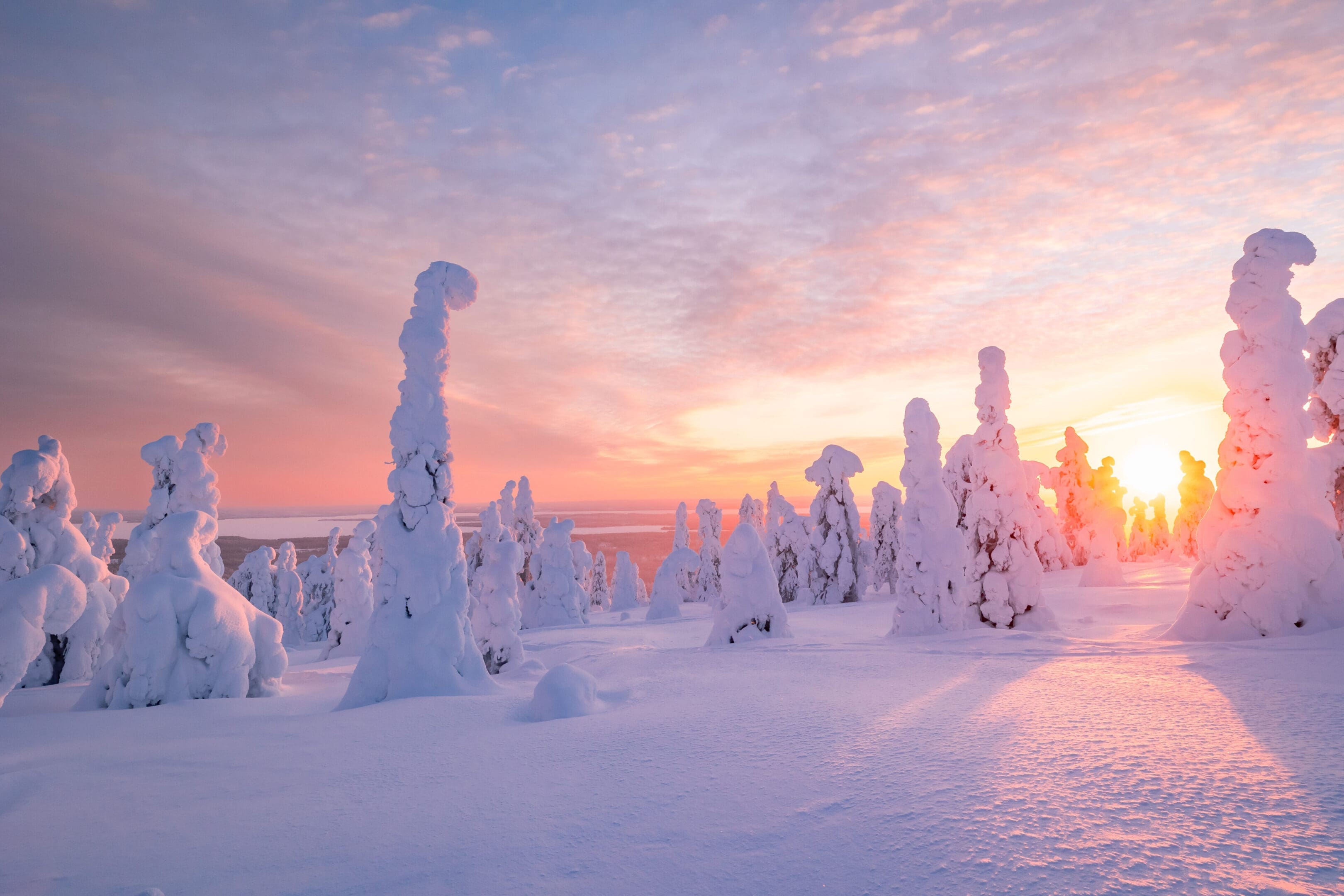
The snow was dry and powdery, nothing like the wet, heavy snow I’m used to at home. Locals call the thick accumulation on tree branches tykkylumi — snow that transforms entire forests into what look like marshmallow trees. Soft white mounds balance delicately on pine limbs, lining roads that feel more like scenes from a storybook.
I’ve seen snow before.
I’ve never seen snow like this.
In Finnish Lapland winter feels engineered for beauty. The roads are maintained. The air is crisp but not biting in the way I expected. The silence is real.
But while the magic is effortless, the planning shouldn’t be.
If you’re considering a winter trip to Finnish Lapland, timing matters. Choosing where to stay matters. Knowing whether to rent a car matters. Understanding how the seasons shift and what that means for activities, snow conditions, what you pack and Northern Lights visibility matters.
After husky safaris, reindeer encounters, snowshoeing across frozen lakes, sauna plunges, and chasing the Northern Lights in two different regions, here’s what we learned — and what we would do differently next time.
Table of contents
- Where Should You Stay?
- The Best Winter Activities in Finnish Lapland
- Rovaniemi vs Levi – Which Should You Choose?
- Where We Stayed – Apukka Resort vs Northern Lights Village
- Where We Ate in Rovaniemi & Levi (Beyond the Resorts)
- Finnish Lapland Winter Logistics: Airports, Driving & Car Rental Tips
- Best Time to Visit Finnish Lapland: High vs Shoulder Season Explained
- What We Packed vs What We Actually Used (Arctic Winter Edition)
- Photographing the Northern Lights & Arctic Winter – What Worked for Us
- Final Photography & Drone Takeaway
- Final Thoughts on Visiting Finnish Lapland in Winter
Where Should You Stay?
If you’re planning a winter trip to Finnish Lapland, one of the most important decisions you’ll face is where to stay.
The region includes several established winter towns — including Rovaniemi, Levi, Saariselkä, Ylläs, Pyhä-Luosto, Ivalo, and Kilpisjärvi — each offering a slightly different atmosphere and access to activities.
We chose to split our time between Rovaniemi and Levi, and they felt distinctly different.
Rovaniemi: Accessible, Festive, Activity-Forward
Rovaniemi is often the entry point to Lapland. It’s home to Santa Claus Village — with its range of glass igloos and holiday-style accommodations — as well as well-known Arctic resorts like Apukka Resort, Arctic TreeHouse Hotel, and the Arctic SnowHotel.
If you’re flying into Rovaniemi Airport (RVN), logistics are straightforward — and the town itself feels organized, structured, and easy to navigate.
Rovaniemi has a strong network of established tour operators, and winter activities — from husky safaris and reindeer encounters to snowshoeing, snowmobile safaris, and ice floating — are widely available in and around the city. Many resorts coordinate experiences directly or partner with trusted providers, giving you flexibility without complicated logistics.
With its airport access, Santa Claus Village, and established resorts, it offers a centralized and accessible starting point for many Arctic itineraries. If you prefer convenience, structured scheduling, and minimal driving, Rovaniemi makes an excellent base.
Levi: Quieter, Darker, and Better for Northern Lights
Levi felt different almost immediately.
Smaller. Quieter. More connected to the surrounding landscape.
There is a defined village center — with restaurants, shops, ski access, and walkable infrastructure — but beyond that core, accommodations and cabins quickly disperse into the surrounding wilderness. The result feels less centralized than Rovaniemi and more integrated into the landscape.
Levi is also home to some of the most popular ski slopes in Finland. During peak winter months, it draws both international visitors and Finnish travelers who come specifically for the skiing.
Even so, it never felt crowded. The slopes were expansive, and the village felt active but not chaotic — with plenty of space to move comfortably.
With less concentrated light pollution — especially if you’re staying outside the village center — Levi can offer strong Northern Lights visibility.
Winter activities are just as robust here: husky safaris, snowmobile safaris, reindeer experiences, skiing, snowshoeing, and ice floating are widely available. But the overall experience often feels more nature-forward and less event-focused.
If you’re drawn to darker skies, ski access, and a slightly quieter atmosphere — without sacrificing infrastructure — Levi may feel more immersive.
Outdoor & National Park Access
If frozen waterfalls and national park hiking are high on your list, this is where regional positioning matters.
The Rovaniemi area offers easier access to destinations like Korouoma Canyon — known for its dramatic frozen waterfalls — and Riisitunturi National Park, famous for its snow-laden “marshmallow” trees.
Levi sits closer to Pallas–Yllästunturi National Park and is particularly strong for skiing, fell hiking, and expansive alpine terrain.
We didn’t make it to Korouoma or Riisitunturi this time — a hard choice for someone who will travel out of the way to see a waterfall — simply because we prioritized Arctic activities and splitting time between Rovaniemi and Levi. If winter hiking and frozen waterfalls are a top priority for you, I would consider anchoring your itinerary closer to Rovaniemi and building in an extra day. That’s the trade-off in Lapland: you can’t do everything in a short stay — so clarity around your priorities matters.
The Best Winter Activities in Finnish Lapland
Lapland isn’t just about seeing snow — it’s about moving through it.
From the sound of huskies pulling across a frozen lake to stepping from a lakeside sauna into Arctic air, these were the experiences that defined our trip.
While most operators in Finnish Lapland are reputable, taking a moment to choose providers who prioritize animal welfare, cultural respect, and small-group experiences can elevate your trip from memorable to meaningful.
Husky Safari: Cinematic, Ethical and Surprisingly Personal
If you only book one Arctic activity, make it a husky safari.
Standing behind the sled as a team of huskies launches forward across a frozen lake is something you feel in your chest. The landscape opens wide. The forest quiets. The only sound is paws hitting packed snow and the sled runners gliding behind you.
But I’ll be honest — I struggle with animal experiences.
Before booking, it mattered to me how the dogs were cared for. I wanted to know:
• How many runs they do per day
• Whether they have rest days
• What kind of shelter they have
• If veterinary care is provided
• How training works
What we learned shifted my perspective.
Huskies are built for cold. They love to run. And they are not subtle about it.
When the sleds ahead of us paused briefly, our team immediately turned around and looked at my husband as if to say, “Why are we stopped? Let’s go.” They barked their opinions loudly. It was clear — they weren’t being pushed. They were impatient to keep moving.
The farm we visited races their huskies beginning in March, which means they receive the entire summer off from heavy work. Training resumes lightly in August, when temperatures are still too warm for long runs. During this time, they run shorter distances and cool off with swims in the river behind the farm.
As winter approaches, small amounts of weight are gradually added so the dogs build strength safely before peak sled season from December through February — preparing them for March racing.
Seeing that rhythm — rest, gradual conditioning, purpose-driven training — changed the experience for me. It felt less like tourism and more like partnership between musher and dog.
After the safari, we were able to spend time with our team — petting them, thanking them, and letting them burn off the last of their energy. Then we warmed up around a fire inside a traditional wooden hut (a kota), sipping warm berry juice and eating cookies while the guides shared stories.
It was equal parts adventure and understanding.
If ethical treatment matters to you, ask questions. The right operator will welcome them.
How to Choose an Ethical Husky Experience
When choosing a husky experience in Lapland, ethics matter.
The dogs should look eager to run — not hesitant. At reputable farms, huskies are bred to work and genuinely thrive in cold, high-energy environments. Running isn’t punishment for them — it’s instinct.
Here are a few things I looked for when researching providers:
• Clear information about how many runs dogs complete per day
• Designated rest days
• Proper shelter and veterinary care
• Transparency about training practices
• Smaller group sizes when possible
The farm we visited race their huskies beginning in March, which means they spend much of the summer resting and gradually returning to training in late August when temperatures drop. Early training includes short runs often paired with cooling swims in nearby rivers. Weight is added gradually as winter approaches to prepare them for sled work and racing season.
Understanding that cycle made the experience feel more aligned with the dogs’ natural rhythms rather than purely tourism-driven.
If an experience feels rushed, overcrowded, or unclear about how the animals are cared for, it’s okay to ask questions — or choose another provider.
What to Expect at a Smaller Husky Farm
Most smaller farms operate with limited parking, so you’ll typically meet in a central location and ride together in a bus to the property.
Once you arrive, instructions are given on how to control the sled. Listen carefully — but know this:
The moment instructions end, things move quickly.
The dogs are excited. They’ve been waiting. They’re ready to run.
Sled assignments are based on dog teams and guest weight distribution. As soon as everyone is positioned and the handlers release the teams, you’re off.
There isn’t a lot of time to:
• Adjust layers
• Fumble with cameras
• Pull your neck gaiter into place
Be fully bundled before stepping off the bus.
It gets windy — not because of the temperature alone, but because you’re moving quickly across open snow.
The energy is electric. The dogs want to go.
And they make that very clear if you stop for too long.
Best For: First-time Arctic travelers and anyone wanting an immersive outdoor experience.
Would I Do It Again? Without hesitation — especially when confident in the care behind the experience.
Ice Karting: Sliding Into Arctic Joy
Just when Lapland started to feel serene and meditative, ice karting reminded us that winter can also be fast.
My husband was initially hesitant about renting a car and driving in Finland — the idea of icy roads in sub-zero temperatures didn’t exactly scream “vacation ease.”
But sliding around a frozen track in something that felt like real-life Mario Kart? Immediate yes.
There were two 20-minute sessions, which was the perfect amount of time to find your rhythm without freezing. Studded tires gripped the ice as you banked into curves, corrected spins, and tried not to oversteer into a snowbank.
The first lap feels cautious. The second gets competitive. By the end, you’re leaning into the turns with far more confidence than you expected.
Between sessions, our group warmed up around a fire, stamping boots and laughing about near-misses while waiting for the second round. When it was time to return to the track, they flipped the direction — forcing you to relearn the course from the opposite angle.
It kept things interesting.
Unlike sauna or floating, this wasn’t reflective or ritualistic.
It was pure, uncomplicated fun.
Best For: Travelers who want an energetic contrast to slower Arctic experiences.
Would I Do It Again? Yes — especially after watching initial hesitation about driving in Finland turn into full-throttle enthusiasm on the ice track.
Reindeer Farm & Snowshoeing: Culture, Landscape, and Honest Reflection
Our reindeer experience began at a small family farm — which was important to me.
I did quite a bit of research beforehand to find an operator I felt comfortable supporting. This wasn’t a large commercial setup. It was a working family farm rooted in Sámi and Finnish traditions.
We started by feeding the reindeer — which was surreal in its own way. Watching them play, nudge each other, and move as a group made it clear they are deeply social animals.
Then came the walking portion.
Our guide explained that when you walk a reindeer, it needs to understand you’re the “boss” — meaning a firm grip on the rope and clear direction about which side it should walk on.
I’ll be honest — that didn’t fully resonate with me.
I missed that instruction initially and instinctively gave the reindeer a bit more freedom. What followed was a slightly comedic dance in which he very confidently decided he was, in fact, the boss.
He won.
It was humbling, funny, and revealing.
While I appreciated the experience, this was the activity I wrestled with most. I had been comfortable with the idea of a short reindeer safari — historically used as transportation by the Sámi people — but walking one felt different.
That said, what I valued most wasn’t the rope in my hand. It was what we learned afterward.
Inside the family cabin, we warmed ourselves by the fire with hot berry juice and roasted marshmallows. Later, after snowshoeing, we returned for hot chocolate topped with whipped cream (the Finnish version), blueberry pie squares, and roasted beef sausages cooked over open flame.
Around that fire, we learned about reindeer herding culture and the rhythms of life in Lapland.
Each reindeer is marked, and those marks are registered — a way families identify their animals when they roam freely in the wilderness. Before winter, farmers gather their herds from the wild. After the snow melts and the reindeer can forage on their own again, they are released back into the landscape.
They are pack animals and tend to stay together, even when roaming freely.
The history of reindeer herding is deeply intertwined with Finland’s past — including its complex relationship with Russia — and remains a living part of the region’s identity.
After the cabin, we strapped into snowshoes and walked across a frozen lake toward what the locals call “marshmallow trees” — snow-laden pines thick with powder.
There was a large, square inflatable frozen into the lake, which I can only assume helps monitor ice conditions. Standing there, surrounded by white in every direction, felt expansive.
Snowshoeing is more demanding than it looks — especially climbing steep, snow-covered inclines in the forest.
But the reward was waiting.
As we turned back toward the lake, the sky shifted to purple and pink. Standing in the middle of a frozen lake, tree lines framing the horizon, under a sky that looked almost painted — that moment felt surreal.
If the reindeer portion left me thoughtful, the snowshoeing portion left me grateful.
Choosing a Respectful Reindeer Experience
Reindeer experiences in Lapland are often connected to Sámi culture, which makes choosing the right operator important — not just for animal welfare, but for cultural respect and authenticity.
Look for providers who:
• Share information about Sámi heritage and traditions
• Keep group sizes reasonable
• Avoid overly commercialized or rushed experiences
• Treat the reindeer calmly and without visible stress
A good reindeer experience should feel educational and intentional — not staged.
If something feels rushed or overly performative, trust that instinct.
Best For: Travelers wanting cultural context paired with quiet landscape immersion.
Would I Do It Again? Yes — for the learning, the snowshoeing, and the perspective it offered.
Arctic SnowHotel: Impressive Craft
We visited the Arctic SnowHotel near Rovaniemi for a short tour — roughly an hour to an hour and a half, including a stop at the ice bar for a mocktail and a round of snow tubing.
It wasn’t crowded, and some of the carvings inside the rooms were genuinely impressive. Walking through corridors built entirely of snow and ice is undeniably unique.
But overall, it felt more novelty-driven than immersive.
Some rooms showcased intricate, thoughtful design. Others felt less refined.
I was especially glad we hadn’t made reservations to stay overnight or dine there. Touring it satisfied my curiosity without committing significant time to something that didn’t feel as grounded in landscape or culture as our other experiences.
That said, there was one unexpected highlight. For the first time ever, I went snow tubing — sliding down a hill toward a frozen lake at sunset. Watching the sky soften into pastels while laughing uncontrollably on the way down was pure joy.
Best For: First-time Arctic visitors curious about snow hotels, families pairing it with other on-site activities such as snow tubing, snow sauna or novelty dining as well as travelers wanting a short visit rather than an overnight commitment.
Would I Do It Again? I’d absolutely snow tube again but not necessarily here. I’d also be open to visiting another snow hotel to see how it compares. This particular visit felt complete as a short stop, but I’m curious how other properties approach the concept.
Sauna & Arctic Water Experiences in Lapland
Sauna isn’t a novelty in Finland. It’s cultural. Foundational. Interwoven into daily life.
In Lapland, that tradition takes on an Arctic edge. From floating saunas frozen into lakes to full-body immersion experiences in sub-zero water, these rituals became some of the most grounding moments of our trip.
Here’s how each experience differed — and what we learned.
Floating Sauna & Arctic Plunge: A Finnish Ritual, Reimagined
If husky sledding was cinematic, the sauna felt foundational.
Sauna isn’t a novelty in Finland — it’s woven into daily life. It’s cultural. Communal. Ritualistic.
We booked a private two-hour floating sauna experience at Apukka Resort on our first evening, after dinner at the resort restaurant — and I’m so glad we did.
The sauna itself sits on the lake. In February, it was frozen into the ice — suspended in stillness, surrounded by white. Knowing we were technically floating, even while encased in winter, made the experience feel even more surreal.
The structure itself had two spaces, and the setup made it effortless. You first step into a changing area with wooden benches, bottled water, fresh towels, plush robes, and slippers waiting for you — warmer than outside, but transitional. A buffer between Arctic air and what comes next. It was lit dimly — only the glow from outside and the fire in the next room — which deepened the ambiance.
Then you open the inner door to the sauna.
Inside, the heat hits differently.
It doesn’t roar — it surrounds. It presses in and takes your breath in a completely different way than the water will later. The air feels dense. Intentional. Alive with steam as water hits the stones.
The first inhale is sharp. The second is steadier.
And slowly, your body adjusts.
Our guide suggested three or four sequences of sauna followed by cold plunge. “It gets easier each time,” he said.
He wasn’t wrong.
Stepping from the sauna into sub-zero air is sharp. Lowering yourself into Arctic water — carved directly into the frozen lake — is a mental negotiation. The advice was to exhale as you sink, to release your breath rather than brace against the cold.
That was easier said than done.
Your breath catches instinctively. Your body resists. And then — if you let it — something shifts.
By the third round, the contrast feels less shocking and more clarifying. Your senses sharpen. Your skin tingles. You climb back into warmth not as a tourist checking off an activity, but as someone participating in something deeply Finnish.
Choosing the private experience made a difference. The pace felt unhurried. The silence felt intentional. It didn’t feel performative — it felt personal.
As an introduction to Lapland, it was grounding, invigorating, and unforgettable.
Best For: Travelers seeking cultural immersion with comfort.
Would I Do It Again? Without hesitation — especially as a first-night ritual.
Sauna Carriage: Nordic Tradition, Delivered to Your Door
Just when we thought we understood sauna culture, it quite literally arrived at our doorstep.
At the time of our reservation, the sauna carriage was delivered directly in front of our cabin. No long walk across the snow. No transition space. Just steam-ready warmth parked outside.
The session was 90 minutes and included towels, robes, and slippers — making it feel seamless and thoughtful.
Unlike the floating sauna, this one was more compact. There weren’t two separate rooms. You climbed a short set of steps to a small porch with built-in wooden seating on esch side, the door to the sauna centered between them.
The porch seating quickly became part of the rhythm.
They were perfect for cooling off between rounds — sitting outside in crisp Arctic air, wrapped in a robe, letting your body recalibrate before stepping back into the heat.
Inside, the warmth builds quickly in the smaller space. It feels intimate. Less ceremonial than the floating sauna — but equally Finnish.
If the floating sauna felt reflective and immersive, the carriage felt playful and convenient. A reminder that in Finland, sauna isn’t confined to lakesides or resorts. It adapts. It travels. It meets you where you are.
Best For: Travelers wanting a private, relaxed sauna experience just steps from their cabin door.
Would I Do It Again? Yes — especially for the ease after a full day.
Ice Floating: Surrendering to the Arctic
If the sauna taught us contrast, ice floating taught us trust.
You don’t step into the lake casually — you descend. Slowly. Carefully. Down a metal ladder into a carved-out section of the frozen lake large enough to drift and float freely.
The first instinct is to grip tightly.
Once your body is fully submerged inside the thermal survival suit, you lean back — and let go.
You have to trust that you will float. That the built-in pillow will rise beneath your head. That the water, despite its temperature, will hold you.
It does.
Floating there felt surreal. Quiet. Otherworldly.
You drift gently across the open section of water, occasionally bumping into surrounding sheets of ice — some thin enough to crack and give way so you can float farther, others too thick to budge. The contrast between fragile and immovable ice beneath a vast Arctic sky was something I won’t forget.
Unlike the plunge — sharp and decisive — ice floating is sustained. You aren’t shocking your system. You’re surrendering to stillness.
I expected adrenaline.
What I felt instead was calm.
Getting out, however, was its own Arctic lesson.
You float back toward the ladder and force your legs downward to find the submerged steps — not an easy feat when buoyancy is working against you. I managed to get my feet onto the ladder, but the top steps were coated in ice.
That’s when things got interesting.
One foot planted — and stuck. Frozen firmly against the icy step. The guide calmly instructed where to shift my weight, but eventually had to use both hands to pry my foot free so I could climb out.
Humbling? Yes. Memorable? Absolutely.
Afterward, we returned to a warm wooden cabin to peel off the suits, sip hot berry juice, and eat ginger cookies while sharing stories. The guide also took photos of each of us entering the water and floating — included in the experience — which made it easier to stay present rather than worry about capturing it ourselves.
Sizing Matters – Don’t Skip
We knew sizing mattered — what we didn’t realize was that availability would be limited.
The thermal suits must fit properly for buoyancy and mobility. If the suit is too large or too small, participation may not be possible. In our case, a sizing issue prevented my husband from getting in — which naturally shortened my time in the water as well.
If you’re booking ice floating, confirm sizing requirements ahead of time and communicate measurements clearly. It’s a small detail that can significantly impact the experience.
Best For: Travelers open to something unconventional and unexpectedly meditative.
Would I Do It Again? Yes — with confirmed sizing and everyone able to participate. The stillness and surrender are unmatched (and now that I understand the ladder exit strategy, even better).
Rovaniemi vs Levi – Which Should You Choose?
If you only have three nights and want simplicity, Rovaniemi is an efficient base — especially if visiting Santa Claus Village, stepping over the Arctic Circle, or leaning into the festive, Christmas-forward atmosphere appeals to you. While parts of it can feel commercial, it’s also iconic and uniquely tied to the region’s identity.
If Northern Lights visibility or alpine terrain matter most to you, Levi may be worth the extra drive — especially during peak winter months when skies are clear and dark.
Both towns offer strong infrastructure, airport access, and coordinated Arctic activities — the difference comes down to atmosphere and focus.
If you have four to five nights, splitting time between both offers the best of both worlds.
Where We Stayed – Apukka Resort vs Northern Lights Village
We stayed at two well-known Arctic resorts — Apukka Resort near Rovaniemi and Northern Lights Village in Levi. Both offer glass-roof accommodations designed for Northern Lights viewing, coordinated winter activities, and on-site dining.
They felt very different.
Apukka Resort (Rovaniemi)
We stayed in the Kammi Suite — a two-story glass cabin with separation between living and sleeping space. Most of the glass exposure was upstairs, which created a greater sense of privacy compared to fully glass walled layouts.
The staircase design was a bit unconventional (clearly designed so you step on specific sides), but it became intuitive quickly.
Across the property, materials like warm woods, softer lighting, and varied building placement created a cozier, more layered atmosphere. Even during peak dining hours, walkways and cabin areas rarely felt crowded.
The glass ceiling upstairs was beautiful and clear, though the framing structure slightly limited lower-horizon viewing. We saw the Northern Lights our first night here, though they appeared lower on the horizon. Our second night was fully clouded over.
Parking is located near the main building, and designated vans transport guests and luggage to cabins. Despite the size of the resort, shared spaces felt spread out and thoughtfully designed.
Apukka also offers a wide range of on-site activities in its private wilderness area — from husky rides and reindeer encounters to snowshoeing, cross-country skiing, and a toboggan hill for families. The variety makes it possible to fill multiple days without leaving the property, which can be especially appealing in deep winter.
It’s worth noting that Apukka also offers more fully glass-exposed cabin styles similar to what we experienced in Levi. Our experience reflects the specific cabin type we chose.
Overall, Apukka felt warm, private, and thoughtfully designed.
Northern Lights Village (Levi)
At Northern Lights Village, the design leaned more minimalist and centralized. The cabins, while not dramatically closer together, sit nearer to the main building — and combined with the glass-heavy architecture, the property felt more visible and active.
One important note at Northern Lights Village: with the glass exposure and cabin design, privacy is limited once interior lights are on. Changing requires fully closing the bathroom door, and at night the cabin can feel somewhat “fishbowl-like” from the outside.
Because cabins are positioned closer together and near walkways, motion-sensor porch lights frequently activated when guests passed by. Those lights were visible not only outside, but from inside the cabin as well — occasionally illuminating both the view and portions of the interior, which can impact Northern Lights photography.
The upside? The glass clarity was excellent, making it easy to scan the sky from bed when conditions allowed. We saw the lights every night in Levi, with visible color beyond just green.
Luggage was transported via snowmobile trailer to the cabin during check-in, and a van assisted with luggage on departure morning.
Overall, Northern Lights Village felt more centralized and visibility-forward — with excellent Northern Lights potential and a livelier resort atmosphere.
Cabin Comfort & Winter Design Details
Both properties are thoughtfully built for Arctic winter. The glass panels are equipped with heating elements to melt snow accumulation, bathroom floors are heated, and each cabin includes an electric fireplace for added warmth and atmosphere.
Despite outside temperatures dipping into the -20°C to -30°C range during our stay, the cabins remained consistently warm and comfortable.
Both properties included complimentary high-speed WiFi and daily breakfast, which simplifies planning — especially during longer winter stays.
Northern Lights Visibility
We saw Northern Lights activity every night in Levi — long stretches, bright displays, and even colors beyond green. The glass clarity in our cabin was excellent, and viewing from bed was effortless — especially when temperatures dropped well below zero.
At Apukka, we saw Northern Lights one night — faint and lower on the horizon. Because of the roof angle in our two-story Kammi cabin, the positioning made lower-horizon activity harder to see directly from the upstairs bed. The second night was fully clouded over.
Of course, Northern Lights viewing is weather-dependent — but during our stay, Levi outperformed.
It’s also worth noting: even though we rented a car, we never had to chase the Northern Lights. Both resorts offered direct viewing from the property.
Food & Dining
This was the clearest difference.
Apukka’s breakfast buffet was extensive — multiple rows including Finnish specialties, fruit, omelet station, breads, juices, and even a chocolate fountain. Dinner was served in distinct restaurant spaces (Aitta and Kota), which felt more curated.
While some dishes across Lapland leaned mild in seasoning, Apukka’s dining experience felt stronger overall.
At Northern Lights Village, dinner operates as a buffet. Guests are seated upon arrival, and I could see waits forming during peak hours. After arriving late our first evening, we chose to eat at the resort. We found the buffet underwhelming. It’s worth noting that we typically prefer plated dinners over buffets — especially after long activity-filled days — so this likely influenced our perception.
After our first night, we chose to dine in Levi’s city center instead.
The common lounge area at Northern Lights Village — with couches and a fireplace — did feel cozy. The restaurant experience, however, felt more functional than culinary.
Where We Ate in Rovaniemi & Levi (Beyond the Resorts)
While both resorts offered on-site dining, we also made a point to explore a few local spots — and some of those meals ended up being the most memorable of the trip.
The Salmon Place – Santa Claus Village (Rovaniemi)
We arrived about ten minutes before opening and were invited inside to sit by the fire while we waited — a small gesture that set the tone.
The hut itself is tiny, warm, and intimate. Salmon is cooked over an open fire in front of you — simple, traditional, and unpretentious.
It was the best salmon I’ve ever eaten.
The crust, the seasoning, the smokiness — everything felt intentional and deeply flavorful. By the time we left, a line had formed outside and wrapped into the yard. Seating is limited, so go early if you can. If you’re visiting Santa Claus Village, this is absolutely worth your time.
Pizzeria Via Tribunali – Levi City Center
After our first night at Northern Lights Village, we chose to explore Levi’s city center for lunch and dinner — and Pizzeria Via Tribunali was a standout.
Originally founded in Helsinki in 2017 (and opened in Levi in 2025), Via Tribunali serves authentic Neapolitan pizza and holds AVPN certification (Associazione Verace Pizza Napoletana) — an international designation recognizing traditional Neapolitan standards.
A few cultural differences stood out immediately:
- Each person orders their own pizza (even children)
- Pizzas are served uncut
- Most diners eat with a fork and knife
We started with the Bresaola appetizer and one of the best Caesar salads we’ve ever had — crisp, balanced, and deeply flavorful. (You can add crayfish or soy-based options, but we kept it traditional.)
My husband and I like to order multiple pizzas to try more than one flavor. We planned to split a Con Salame and a Diavola — and the staff kindly made each of our pizzas half-and-half so we could both sample both varieties.
After several days of lighter seasoning throughout Lapland, this meal felt like a reset. Bold. Balanced. Memorable.
For context: my husband is a serious foodie, and pizza is practically one of his food groups. This delivered.
King Crab House – Levi City Center
King Crab House came recommended and we were excited to try Arctic seafood.
We began with the soup and king crab cakes. Both were flavorful and well-prepared.
Then we ordered the King Crab House seafood platter, assuming it would be sufficient for the two of us to share.
What we didn’t realize is that the pricing is per person (78€ per person), even though the platter is served for a minimum of two.
The menu structure can be unclear if you’re not reading carefully — and because we ordered everything at once, we didn’t realize some items (like crab cakes) were already included in the platter.
While we appreciated the opportunity to sample multiple Arctic seafood preparations, we found ourselves enjoying primarily the king crab legs and mussels. The other components were less aligned with our personal taste preferences.
It ended up being our most expensive meal in Finland — and, for us, not the strongest value.
If you visit, just be sure you fully understand the pricing structure before ordering.
Finnish Lapland Winter Logistics: Airports, Driving & Car Rental Tips
Winter logistics in Finnish Lapland are different than what many travelers expect — especially if you’re renting a car and navigating in deep winter conditions. From airport flow to fueling and one-way returns, small details can make the experience feel seamless — or confusing.
Here’s what we learned.
Arriving in Rovaniemi (RVN)
We arrived in mid-February, peak winter season — and the airport was busy.
Rovaniemi Airport is small, with only two baggage claim belts (that I saw). When multiple flights land close together, it can feel congested. The baggage area doubles as a kind of welcome display for the region — with signage and Arctic-themed visuals — so plenty to keep you entertained while you wait for your luggage.
After collecting luggage, rental car counters are located down a hallway to the left as you approach the airport exit. Luckily, our Avis counter wasn’t busy.
We rented an SUV, which I recommend in winter. The next step: walking out into the snow-covered parking lot to locate the numbered space assigned to our vehicle.
Dragging luggage through snow for the first time? That was our official Arctic welcome.
Looking up to see the snow-covered “marshmallow trees” for the first time — completely surreal.
In hindsight, my husband could have located the car and then driven to the covered drop-off area near the airport exit to pick me and the luggage up. That area, however, was very busy with cars and buses at the time — which is why we chose not to. If you’re comfortable navigating the traffic and have patience, using the covered curbside area for pickup is an option.
What Driving Was Actually Like
While historical averages hover between -9°C and -16°C in mid-February, thermometers at our resorts and throughout town frequently displayed -23°C to -30°C during our stay.
Despite the deep cold, the roads felt surprisingly manageable. The snow was compacted rather than icy sheets, and winter tires provided stable traction.
What looked intimidating on paper felt calm and controlled in reality.
Parking in Santa Claus Village & Levi
Santa Claus Village has designated parking areas — be sure to park in approved lots.
In Levi’s city center, parking can feel less intuitive. When we first parked (in a space beside another vehicle with no obvious signage), our husky guide kindly informed us we needed to move the car.
While signage may not always be obvious, there are designated areas and zones that aren’t immediately clear to visitors.
Take a moment to confirm before settling in.
Fueling Up (Diesel & Payment Differences)
Our rental vehicle was diesel — which is common in Finland — so make sure you confirm what type of fuel your car requires before pulling up to the pump.
Fueling was an experience in itself.
Unlike most U.S. stations:
• The card payment terminal is separate from the pump
• Debit cards were not accepted — only credit cards
• You must pre-authorize an estimated amount
We estimated €20 (having no real idea what we’d need), and thankfully the system adjusts and charges only for the exact amount used — even if you exceed your estimate.
Stations are often self-service, so allow a few extra minutes if it’s your first time navigating the system.
It was a small but memorable cultural adjustment.
Returning the Car in Kittilä (KTT)
We returned our car at Kittilä Airport for our onward flight.
Avis was not yet open, so we:
• Parked in a designated Avis return spot
• Walked luggage through the snow to the rental building
• Dropped the key in the overnight return box
• Continued pulling luggage to the airport terminal
It wasn’t a long walk — but it wasn’t short either.
In hindsight, we likely could have temporarily dropped luggage at the curb before parking.
Once inside, however, check-in was quick and there were no lines.
Security procedures required removing all electronics and liquids — more thorough than what we’ve experienced recently in the U.S. or other parts of Europe — but because the airport wasn’t crowded, the process moved smoothly.
Rental Deposit & Charge Timing
One small logistical note worth mentioning:
After returning the car in Kittilä, the final charge did not immediately close out on our credit card. The pending charge including deposit remained pending for over a week.
After reaching out directly to the local Avis office in Rovaniemi, the transaction was finalized and the hold was released shortly thereafter.
This may vary by location, but it’s helpful to know that processing timelines may not be instant — especially with one-way rentals between airports.
If you’re monitoring charges closely, allow extra time or follow up proactively.
Best Time to Visit Finnish Lapland: High vs Shoulder Season Explained
Lapland isn’t just “winter” and “not winter.”
Resorts in Lapland define seasons differently based on activity operations and snow conditions — but from a traveler’s perspective, these are the phases that matter most.
Understanding the difference matters.
🍁Autumn (August – October) – Shoulder Season | Northern Lights Without Snow
Autumn marks the beginning of Northern Lights season in Lapland.
By late August and September, skies are dark enough for aurora viewing. Temperatures are cool but not extreme, and crowds are significantly lower than winter high season. Snow is not yet guaranteed — so the landscape feels raw, colorful, and textured rather than postcard-white.
Instead of snow-based excursions, autumn experiences often include:
• ATV forest tours
• Hiking during ruska (Lapland’s vibrant fall foliage season)
• Canoeing and lakeside excursions (early autumn)
• Aurora hunting by vehicle
• Sauna and lakeside cold plunges — without ice
Sauna culture is year-round in Finland, and autumn offers a different kind of magic: mist rising off the lake, golden foliage reflected in still water, and floating sauna experiences that are truly floating — not frozen into the landscape.
You won’t get the full snow-covered “winter postcard” aesthetic. But you will get color, contrast, quieter trails, and strong Northern Lights potential without deep winter cold.
Best for:
• Northern Lights
• Fewer crowds
• Milder temperatures
• Fall color photography
• Travelers who prefer fall color and active outdoor experiences without deep winter conditions
🎄Early Winter (November – December) – Christmas Magic
In November, Lapland begins its shift into winter. Snow starts accumulating, and winter activities gradually come online as the landscape moves from late autumn into full Arctic white.
By late November — and especially in December — much of Finnish Lapland settles into the winter landscape most travelers picture: snow-covered cabins, silent forests covered in white, and festive lights glowing against long polar nights.
This is prime time for:
• Santa Claus Village
• Stepping over the Arctic Circle
• Festive décor and holiday programming
• Snow-covered cabins and forest scenery
Because early winter straddles the line between shoulder and high season, snow reliability can vary in late November. That timing may affect which snow-dependent activities are fully operational. By mid-to-late December, conditions are typically more stable — and the full winter experience is usually in place.
Daylight hours are extremely limited in December due to polar night. The atmosphere feels cinematic and cozy — but also noticeably dark.
Best for:
• Festive atmosphere
• Full Christmas experience
• Travelers who want a classic “Santa’s Lapland” setting
🧊 Deep Winter (January–March) — Full Arctic Experience
By January, winter is fully established.
Snowpack is deep and reliable. Lakes are frozen solid. All major winter activities are operational and consistent — making this the most dependable season for a full Arctic experience.
This is the season for:
• Husky safaris
• Reindeer experiences
• Snowmobile safaris
• Snowshoeing
• Ice floating
• Ice karting
• Full ski access
Temperatures often dip below -20°C, but the cold is dry and manageable with proper layering.
Aurora potential remains strong thanks to long, dark nights and stable winter conditions.
If you want the full snow-covered postcard version of Lapland — this is it.
Best for:
• Reliable snow conditions
• Full winter activity access
• Strong Northern Lights potential
• Travelers who want the complete Arctic experience
☀️Late Winter (March – April) – Spring Ski Season
Late winter transitions toward spring.
Days become longer and brighter.
Ski season remains strong and the landscape stays snow-covered. However, aurora visibility decreases as daylight extends.
Temperatures are typically milder, making this a more comfortable option for travelers sensitive to extreme cold.
Aurora visibility decreases as nights shorten. Best for:
• Ski-focused travelers
• Longer daylight hours
• Slightly milder conditions
So, When Should You Go?
If your goal is the full Arctic experience — snow-covered trees, frozen lakes, maximum snow activity access and strong Northern Lights potential — January through early March is the most reliable window.
If you’re dreaming of Christmas and want to visit Santa Claus Village at its most magical — late November through December is peak festive season.
If your priority is Northern Lights with milder temperatures and fewer crowds, autumn can be appealing — just without the snow-covered landscape most travelers associate with Lapland.
Each season in Lapland offers a different experience — the key is aligning your trip with the type of landscape and activities you’re most excited about.
What We Packed vs What We Actually Used (Arctic Winter Edition)
Mid-February temperatures during our stay frequently hovered between -23°C and -30°C.
Seeing numbers like that makes you want to panic-pack.
The truth? With the right layering system, Arctic winter was far more manageable than it sounds.
The cold is dry, not damp. Crisp, not slushy. And surprisingly comfortable when you dress intentionally.
Our Daily Layering System (What Actually Worked)
Every single day followed the same formula.
Base Layer (Non-Negotiable):
Merino wool top and bottom.
Every day. No exceptions.
Mid Layer (Adjusted by Temperature):
• Fleece top/jacket and fleece lined pants
• Sometimes a sweater in place of or in addition to fleece top/jacket
Outer Layer:
• Waterproof snow pants or snow bib
• Heavy insulated winter coat
I brought two coats:
• A white, shorter ski-style coat
• A longer, hooded North Face coat for deep winter Lapland
I wore the North Face almost exclusively in Lapland. It was absolutely necessary in those temperatures.
Snow Pants vs Bibs
I packed:
• Two snow bibs
• One pair of snow pants
I wore:
• The snow pants the most
• One pair of bibs
• Never touched the second bib
If I packed again:
• One quality pair of snow pants
• One bib max (if at all)
Less bulk. More intention.
Boots & Socks — What Actually Mattered
I only wore one pair of wool socks daily.
My UGG snow boots and Moon Boots kept my feet incredibly warm without overheating — no sweating, no need to double up.
The real takeaway:
Good boots matter more than doubling socks.
And by “good,” I don’t mean expensive. I mean:
• Proper insulation
• Waterproof
• Enough room for circulation
Account for sock thickness when sizing boots. Your toes need room to wiggle. Tight boots = cold feet.
My Moon Boots surprised me. They were just as warm as my heavier snow boots — and much easier to slip on quickly when we needed to run outside to catch the Northern Lights.
That quick-access factor mattered more than I expected.
I also packed a lower pair of UGG boots and never wore them. They just took up space.
Hands, Face & Head Protection (Where I Overpacked)
This is where most people overdo it.
I packed:
• 2 pairs of glove liners
• Pair of thicker gloves
• Mittens
• Heated mittens
• Hand warmers
• Foot warmers
• Neck gaiter
• Beanies
• Scarves
• Extra wool socks
• Earmuffs
I actually used:
• Mittens
• Heated mittens
• One pair of glove liners
• Neck gaiter
• Beanies
• Fewer than half the wool socks
I never used:
• Thicker gloves
• Hand warmers
• Foot warmers
• Extra glove liners
• Earmuffs
• Scarves
My husband preferred a balaclava. I preferred a neck gaiter — less restrictive and easier to adjust.
With my coat zipped fully and a gaiter + beanie on, a scarf wasn’t necessary.
Foggy Glasses & Neck Gaiters
If you wear glasses, expect fogging.
Depending on how high my gaiter sat and how I was breathing, my lenses fogged immediately.
What worked:
• Securing the gaiter more snugly across my nose
• Being deliberate with breathing
• Adjusting airflow downward instead of upward
I considered anti-fog spray but managed without it.
Pajamas & Cabin Comfort
I wasn’t sure how warm the cabins would be, so I packed:
• One heavier pajama set
• One lighter set
I wore both — at different times.
Cabins are heated and well insulated.
Slippers, Swimwear & Sauna Assumptions
I packed:
• Swimsuit
• Lightweight spa slippers
• Robe
I didn’t need the slippers or robe.
Every place we stayed provided both.
Resorts are built around sauna culture, and most provide robes and slippers. If you’re unsure, confirm with your accommodation — it can save valuable space in your luggage.
Jeans & “Normal” Clothes
I packed a couple pairs of jeans.
I never wore them in Lapland.
Warm, functional attire was completely acceptable everywhere — including restaurants in city center Levi.
No one was dressed for fashion. Everyone was dressed for warmth and practicality.
Save the space in your luggage.
Self-Care Non-Negotiables
• Lip balm (ideally with SPF)
• Heavy moisturizer
• Hand cream
• Moisturizer or sunscreen with SPF
• Sunglasses
The Arctic air is extremely dry — and snow reflects sunlight more than you expect. Protect your skin and your eyes.
Hydration matters in more ways than one. Drink more water than you think you need. Cold air suppresses thirst, but you’re still losing moisture throughout the day. Adding electrolytes can help, especially after long outdoor excursions.
Don’t Own Arctic Gear? Here’s What to Know
You do not need to own full Arctic expedition gear to visit Finnish Lapland.
Many resorts and activity providers are prepared for guests who don’t arrive with technical winter equipment.
Some Resorts Include Outerwear for Your Entire Stay
Certain resorts (like Apukka) provide thermal outerwear and boots for the duration of your stay — not just for individual activities.
That means you can:
• Arrive in normal winter layers
• Layer underneath their provided suit
• Use their gear throughout your visit
It significantly reduces packing pressure.
Always confirm what’s included before arrival, as this varies by property and cabin type.
Other Resorts & Tour Operators Provide Gear for Excursions
For guided experiences such as:
• Husky safaris
• Snowmobiling
• Ice floating
• Reindeer encounters
Operators typically provide:
• Heavy-duty thermal suits
• Boots
• Gloves or mittens
• Helmets (for snowmobiling)
These suits are designed for extreme conditions and are worn over your base layers.
When we booked our husky safari through Scandinavia Travel Group / Safarimarket, our guide suggested consider renting their one-piece thermal suit since I’d be sitting as a “passenger princess” in the sled and not mushing.
It cost €10 — and totally worth it.
When you’re seated and not actively driving, you feel the cold differently. The thermal suit added an extra layer of wind protection that made a noticeable difference.
My husband wore what we had packed and was completely fine while driving.
A Note on the “Lapland Aesthetic”
You’ll see photos of travelers in perfectly styled outfits — full makeup, curated winter looks, and aesthetic hair.
That wasn’t my reality.
For me, staying warm and protecting my skin mattered more than looking polished.
I prioritized:
• Moisturized skin
• Wind protection
• Functional layers
• Warmth over fashion
My photos reflect that.
And I’m completely okay with it.
Because being comfortable enough to fully enjoy the experience mattered more than looking curated in it.
Final Packing Takeaway
The cold in Lapland is intense — but it’s dry and predictable.
Layer intentionally.
Wear quality boots.
Protect your face before stepping into wind.
Don’t overpack “just in case.”
And remember, function wins in Lapland
Photographing the Northern Lights & Arctic Winter – What Worked for Us
Arctic winter is visually stunning — but it comes with its own set of challenges.
Cold changes how batteries behave. Snow changes how light reflects. Darkness changes how you shoot.
Preparation matters just as much as composition.
Cameras & Gear We Brought (And What We Actually Used)
Because luggage space was at a premium, I left my Canon RP at home.
My husband brought his Canon EOS R50 with a versatile wide-range lens — which we primarily used for landscapes and a few portraits.
We brought:
• iPhone
• Canon EOS R50
• DJI Osmo Pocket 3
• Insta360 X5
• Insta360 Go 3S
• GoPro
• Meta Glasses
• Drone
• Tripod
What we used consistently:
• Canon EOS R50
• iPhone
• DJI Osmo Pocket 3
• Insta360 X5
• Meta Glasses
• Drone
• Tripod
Each had a purpose.
The iPhone handled cabin tours, quick captures, behind-the-scenes moments, and spontaneous Northern Lights.
The Canon was for intentional shots — landscapes and portraits.
DJI Osmo Pocket 3 and Insta360 X5 were ideal for:
• Husky safari
• Ice karting
• Snow activities
• Immersive POV and movement shots
The Meta Glasses were surprisingly useful for hands free, real-life moments to capture perspective — what it felt like to be there.
What we barely used:
• GoPro
• Insta360 Go 3S
I attempted to use the GoPro once for Northern Lights, but at that moment the aurora wasn’t strong enough to register well. I didn’t reach for it again.
The Insta360 Go 3S mostly stayed in the bag.
Cold conditions make you more selective. When it’s -25°C, the fewer decisions you have to make, the better.
What I’d Streamline Next Time
If packing again for deep winter, I’d likely bring:
• A mirrorless camera with a versatile lens
• DJI Osmo Pocket 3
• Insta360 X5
• Meta Glasses
• iPhone for quick captures and Northern Lights alerts
• DJI Mini 4 Drone
• Tripod
And leave the extra niche action cameras at home.
Bringing multiple overlapping devices sounds efficient in theory — but in -25°C air, the fewer decisions you have to make, the better.
Arctic winter rewards clarity — not gear overload.
Capturing the Northern Lights — What Actually Worked for Us
We used Night Mode intentionally on the iPhone and manually increased the exposure time to capture more light.
Often, the Northern Lights were visible in photo mode before they were strong enough to show clearly in video mode.
One trick we learned:
If the aurora is visible in camera (photo) mode but not yet bright enough for video, you can use screen recording while in camera mode. This creates a “video-style” capture of what the phone is seeing in Night Mode.
It’s not the same as true long-exposure video — but it works surprisingly well until the lights intensify.
The DJI Osmo Pocket 3 was also surprisingly effective for capturing the Northern Lights. Its stabilization and low-light performance made it a strong option for smoother aurora footage — especially when the lights were moving more dynamically across the sky.
We also learned:
• Tripods are essential for mirrorless low-light photography
• Aurora intensity changes quickly — adjust settings fast
• Sometimes your phone reacts faster than expected
In extreme cold, simplicity often wins.
🚁Bringing a Drone to Finnish Lapland in Winter – Legal & Regulatory Considerations
Lapland’s frozen forests and snow-covered lakes feel made for aerial footage.
But Finland takes drone regulations seriously — and winter conditions add another layer to consider.
Here’s what to know before you pack it.
Registration & Licensing (EU Rules Apply)
Finland follows European Union Aviation Safety Agency (EASA) regulations.
If you are flying a drone in Finland:
• You must register as a drone operator in your home EU country (or in Finland if non-EU).
• Your registration number must be displayed on your drone.
• You may need to complete the A1/A3 online training and exam (even recreationally).
If you are visiting from outside the EU:
You may need to register through the Finnish Transport and Communications Agency (Traficom).
Official site to check requirements:
Traficom (Finnish Transport and Communications Agency)
https://www.traficom.fi Regulations can change — always verify before departure.
Airspace, National Parks & Restricted Areas
Drone use in Lapland is regulated — even in remote areas that feel untouched.
Restrictions may apply:
• Near airports (especially Rovaniemi Airport and Kittilä Airport)
• Within controlled airspace zones
• Inside or near national parks
• On private property where prohibited
Finland’s national parks may carry additional limitations beyond general airspace rules. This includes areas such as:
• Riisitunturi National Park
• Pallas–Yllästunturi National Park
• Korouoma Canyon
Before flying, verify both:
• Airspace restrictions
• Park-specific regulations
To check live airspace conditions, use:
Droneinfo.fi (official Finnish airspace portal)
https://www.droneinfo.fi
You can also reference tools like:
• DJI FlySafe
• Airmap
• Altitude Angel
These platforms show:
• Restricted zones
• Altitude limits
• Temporary flight restrictions
Even in wide-open Arctic landscapes, never assume unrestricted airspace. Always verify before takeoff.
Resort Policies Matter
Even when airspace is clear, private property rules still apply.
At Apukka Resort, drone use was permitted.
At Northern Lights Village, clear “No Drone” signs were posted.
Policies vary by property — always ask before flying.
And even when allowed:
• Avoid flying directly over cabins
• Avoid hovering over guests
• Be especially mindful around glass-ceiling accommodations
• Prioritize privacy and keep your distance
Northern Lights viewing can be peaceful — but glass cabins make privacy more sensitive.
Fly accordingly.
🚁 Bringing a Drone? What to Know Before You Fly in Arctic Winter
Lapland looks made for drone footage.
Snow-covered forests. Frozen lakes. Endless white terrain.
But Arctic winter changes the equation.
Weather & Cold Considerations
Cold affects drones significantly.
• Batteries drain faster in sub-zero temps
• Wind feels stronger over frozen lakes
• Snow glare can impact exposure
• Plastic components can become brittle
Keep batteries warm inside your coat before flying.
Expect shorter flight times than normal — sometimes dramatically shorter at -20°C and below.
Plan your shots in advance.
Wind Feels Different in Open Arctic Terrain
Frozen lakes and open tundra create wide, unobstructed wind paths.
What feels calm at ground level can be stronger at 50–100 feet.
Do a short hover test before committing to distance. And remember:
Cold fingers + remote controls = slower reaction time.
Snow = Visual Depth, But Also Exposure Challenges
White landscapes can trick your drone’s exposure settings.
Slight overexposure can wash out detail in snow.
Consider:
• Slight exposure compensation adjustments
• Shooting during golden or blue hour for contrast
• Capturing treelines for depth
Final Photography & Drone Takeaway
Arctic winter rewards preparation.
Prepare your gear like you prepare your layers.
• Keep batteries warm.
• Use a tripod.
• Adjust quickly when the sky shifts.
• Expect light pollution in certain areas.
• Expect the cold to change how your gear performs.
• Snow softens sound.
• Light reflects differently.
• The sky moves in ways that don’t need filters.
The landscape will do most of the work for you.
Lapland is extraordinary from the air — but flying responsibly matters.
• Register if required.
• Check Traficom regulations.
• Use Droneinfo.fi to verify airspace.
• Confirm resort policies.
• Protect battery life in extreme cold.
• Prioritize privacy and atmosphere.
When done thoughtfully, drone footage in Arctic winter can be breathtaking.
When done carelessly, it can feel intrusive.
Choose wisely.
Bring the equipment — but don’t let it distract you.
Because standing in the middle of a frozen lake under a pink and purple Arctic sky…
watching the Northern Lights shift from soft green to something brighter…
That moment matters more than the footage.
Use your camera intentionally.
Fly your drone responsibly.
And remember to lower both long enough to take it in.
Final Thoughts on Visiting Finnish Lapland in Winter
Finnish Lapland in winter is more than a destination — it’s an atmosphere. It’s silence so complete you can hear snow falling. It’s forests sculpted into marshmallow shapes. It’s huskies pulling you across frozen lakes and skies that shift from pale green to something electric.
It rewards preparation. It rewards patience. And when the Northern Lights finally stretch across the sky, it rewards you with something that feels almost unreal.
If you’re planning a winter trip to Finnish Lapland — or deciding between Rovaniemi and Levi — I hope this guide helps you plan intentionally, pack wisely, and experience it fully.
If you’re planning a winter trip to Finnish Lapland — or anywhere that requires thoughtful timing, logistics, and local insight — I design custom travel plans built around how you want to travel, see, and experience a place.
Explore Trip Design and start planning with clarity.