

Seeing the Northern Lights in Finnish Lapland: Where to Stand, Which Apps, What to Expect
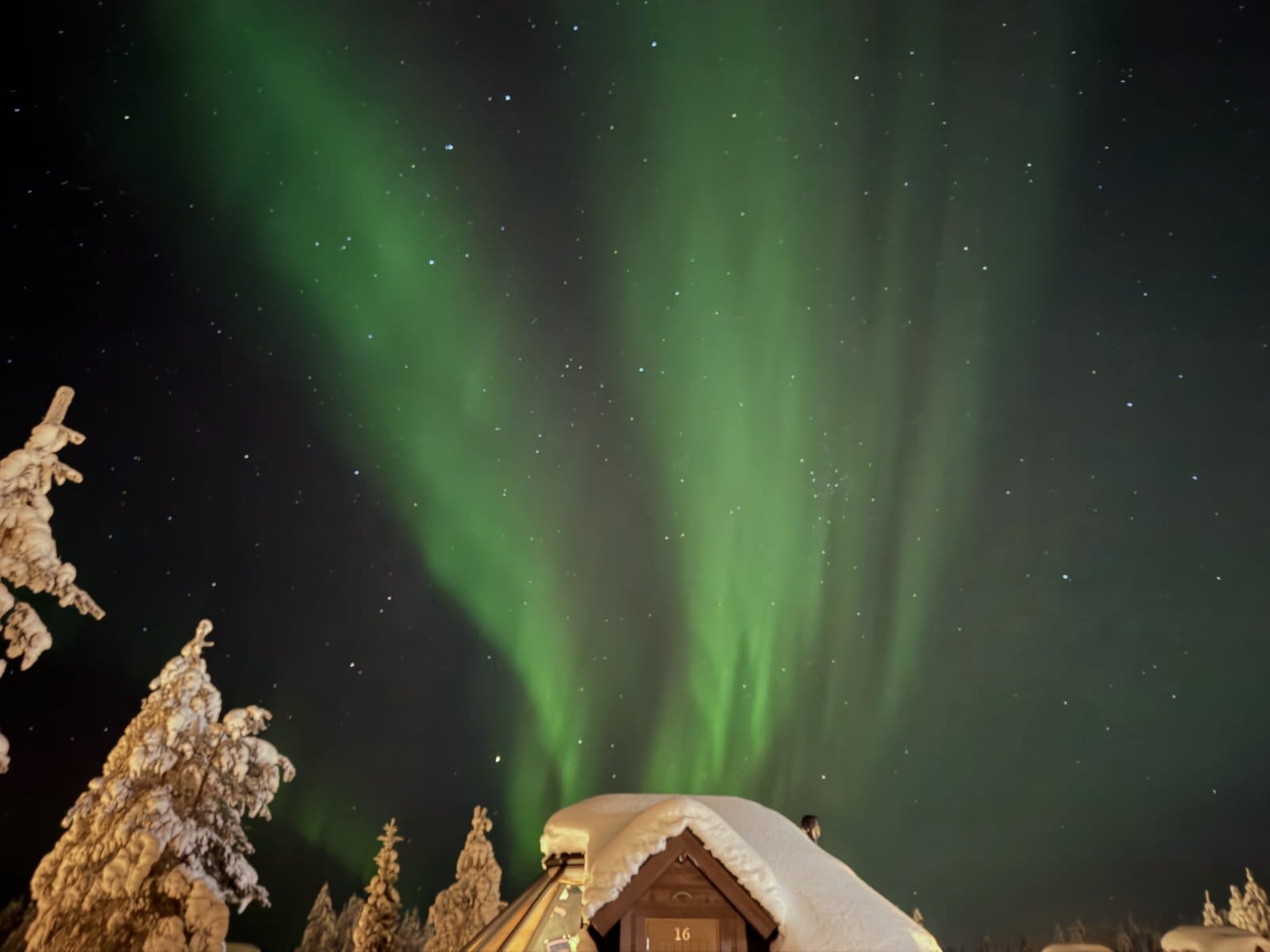
We saw the Northern Lights on three of our four nights in Finnish Lapland, split between Apukka Resort outside Rovaniemi and Northern Lights Village in Levi, 170 km to the north. We never drove anywhere to chase them.
What decided each night was cloud, and where we were standing when the sky opened up. At Apukka the display sat too low for the glass roof, so we went outside for it. In Levi we could watch from bed, and we still kept going out.
This guide covers the season, the odds on a clear night, where to stand, the check to run each evening, and how to photograph the lights with the phone already in your pocket.
WHAT’S IN THIS GUIDE
Disclosure: This post may contain affiliate links. If you book through them, I may earn a small commission at no additional cost to you. I only recommend experiences, accommodations, and services I’ve taken part in personally or researched thoroughly. See our Privacy Policy for more details.
The Tease From the Plane Window
I stayed awake on the overnight flight from Dallas, staring out the window in case the Northern Lights showed up before we even landed. They did, sort of: a faint green band low on the horizon while most of the cabin slept.
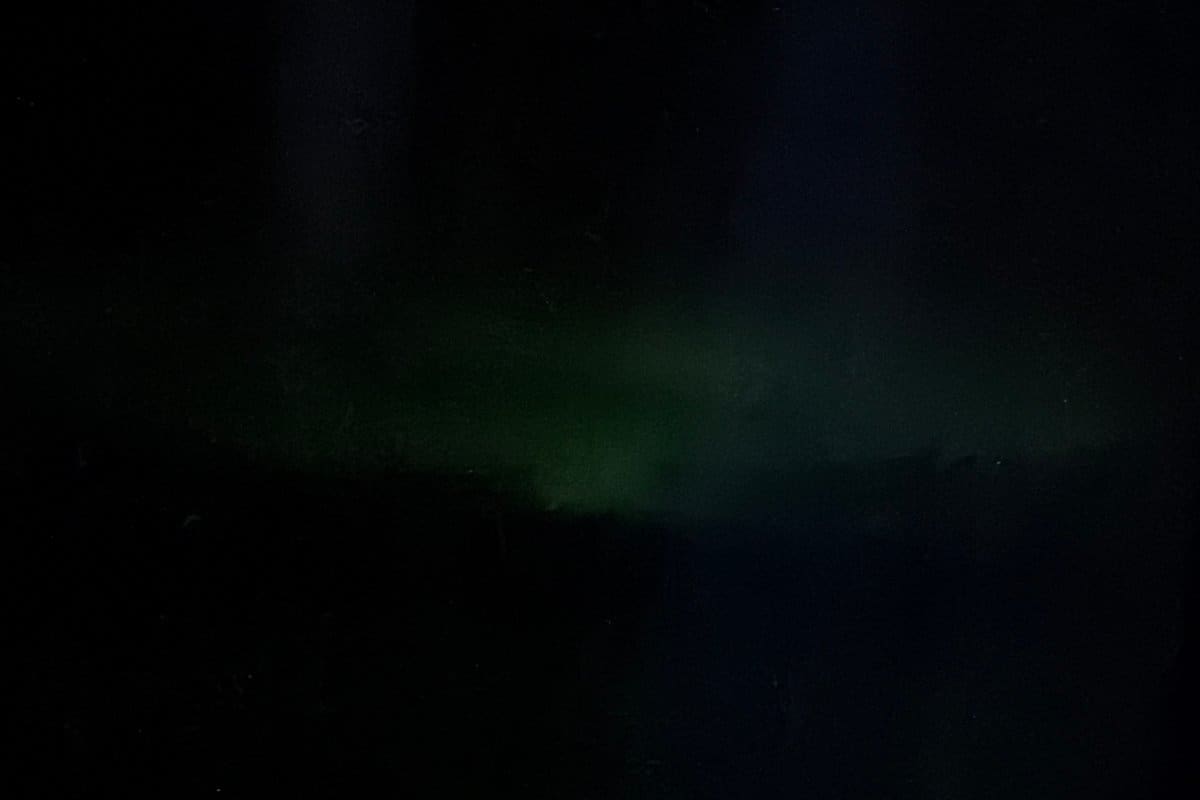
I had already told my husband before we left that if I did not see the Northern Lights, I was not coming home. Looking at that faint little band, I told him again. That was not going to do it for me, and I would be staying in Finland until I really saw them. Lucky for him, they showed up our very first night on the ground. I am even more glad that was not the only night, because Levi put on a show for us both nights we were there.
When the Lights Happen, and Why the Odds Are Good Up Here
Finnish Lapland sits on the southern rim of the auroral oval, the ring where the lights appear on ordinary nights rather than only during a solar storm. That is the whole reason a trip here is worth planning around them: you are not waiting for a rare event, you are waiting for a clear sky.
The season runs from late August to early April, because the rest of the year is too light. Within it, the Finnish Meteorological Institute names February and March as the best stretch, with September and October close behind, and the most active hours between nine at night and one in the morning.
You will read a great deal about the Kp number. It matters less here than the internet suggests. No official source publishes a Kp threshold for Rovaniemi or Levi, and the Finnish Meteorological Institute runs its own local alerts off Finnish magnetometers instead of a global index. Watch the cloud and the local alert; treat Kp as background noise.
The Finnish Meteorological Institute puts the Northern Lights over the Lapland ski resorts, Levi included, on roughly every second night, and over the far north around Kilpisjärvi on three nights out of four. Those are the odds of the sky producing them, not of you seeing them: cloud decides that. There is no published figure for Rovaniemi itself, so treat the popular “200 nights a year” claim as marketing rather than data.
Our Four Nights, Two Bases
We spent the first two nights at Apukka Resort outside Rovaniemi and the next two at Northern Lights Village in Levi, 170 km north. Why we split them, and how to decide if you only have time for one, is in Levi vs Rovaniemi.
Night one at Apukka delivered, but low. The lights sat close to the horizon, and the framing of the glass roof cut off exactly the part of the sky it was in. Standing outside in the snow solved what the bed could not. Night two clouded over completely, which is the part of a Lapland trip nobody puts in a brochure.

Both Levi nights were different. The glass on our cabin was clear to the gable, the lights ran long rather than in short bursts, and there was color past green. We could watch from bed, and we took full advantage of it. We still kept going outside, though: from bed you only see the slice of sky your glass faces, and you keep wondering whether another part of it is putting on a bigger show.


Four nights, three sightings, no chasing. If you are weighing how many nights to book, that ratio is the honest one to plan against, and it is the argument for three nights minimum rather than one.
Under the Glass, Out the Door, or Away From the Lights
Under the glass. A glass cabin earns its price when the room is dark, but how much low sky it shows you depends on the cabin. In a two-story cabin with the glass up in the roof, the Northern Lights can sit below the frame and out of view. On a single level where everything in front of you is glass, the same low display sits right at the foot of the bed. Ask how the glass is laid out and which way it faces, not just how much of it there is.
Out the door. Stepping outside costs you nothing but exposure to the elements, and it gives you the whole sky. Your eyes also get real darkness to adjust to, which takes around twenty minutes.

Away from the lights. At Northern Lights Village the cabins sit close to the walkways, and motion-sensor porch lights fire whenever someone passes. They light the snow, the window and occasionally the photograph. Lapland has far less artificial light than most places, but a short walk or drive out of town, toward a frozen lake or an open fell, still buys you a darker sky.

Before you decide the sky is empty, kill every light inside the cabin, including the bathroom, and give your eyes a full twenty minutes. A faint arc that looks like thin gray cloud through a lit window is often the beginnings of the real thing.
The Check to Run Every Evening
Three steps, in this order, at about nine in the evening.
Clear sky is the single biggest factor, and cloud ends the night entirely. Check the cloud forecast before anything else; if it is solid, the rest does not matter.
The Finnish Meteorological Institute publishes a nowcast for Finland built on its own magnetometers. Yellow means the lights are possible but usually dim. Red means it is very likely you can see them. That plain wording beats any number.
Set one app or, if your resort runs its own Northern Lights alert, sign up for it at check-in so someone else does the watching while you sleep.
We ran two apps side by side. My Aurora Forecast & Alerts gave us the wider picture, with its probability map and a cloud layer. Aurora Alert Realtime let us set alerts for specific places, free of charge, and we had both Apukka and Levi switched on, so the phone did the watching.
For a longer horizon, NOAA’s 30-minute forecast shows where the auroral oval is sitting right now, which is useful when you are deciding whether to get dressed.
→ FMI: AURORAS AND SPACE WEATHER
→ NOAA: AURORA – 30 MINUTE FORECAST
Photographing Them on the Phone You Already Have
You do not need a camera bag to come home with Northern Lights photos. What worked for us was Night Mode with the exposure pushed to its longest setting, braced against something solid, because Apple’s own guidance is that the phone has to stay still until the capture finishes.

The useful discovery: the lights often register in photo mode well before they are bright enough for video. When that happens, open the camera in photo mode and start a screen recording. You get a video-style clip of what Night Mode is seeing. It is not a true long exposure, but it holds up until the display strengthens.

My husband shot with his Canon EOS R50 and a wide-range lens, and for a mirrorless camera in low light the tripod turned out to be essential. The DJI Osmo Pocket 3 surprised us: its stabilization and low-light performance made for smoother footage when the lights moved fast. The GoPro did not earn its space. I tried it once, the lights were not strong enough to register, and I never reached for it again.
If you bring a camera, these settings are a starting point. The light changes quickly, so check the back screen after every frame and adjust as you go.
- Lens and aperture. The widest lens you have, at f/2.8 or faster if it goes that wide open.
- ISO and shutter. ISO 800 to 3200 and 5 to 15 seconds. Go shorter when the lights move fast, or the ribbons smear into a green haze; go longer when the display is faint and still.
- Focus. Autofocus hunts in the dark. Switch to manual and focus on a bright star or a distant light, then leave the ring alone.
- Keep it still. A tripod, plus the 2-second timer or a remote so pressing the shutter does not shake the frame. Turn image stabilization off once the camera is on the tripod.
- Shoot RAW. Color and noise are far easier to fix afterwards.
- Spare batteries, kept warm. Cold drains them just as fast as a phone. Keep the spares in an inside pocket.
- Bag it before you go in. Put the camera in a zip bag or its case before you step indoors and let it warm up slowly, so condensation forms on the bag and not inside the lens.
Cold drains a phone fast. Keep it inside your jacket between shots, carry a charged power bank, and expect the battery percentage to jump back up once the phone warms indoors.
Tours Versus Staying Put
A guided Northern Lights hunt sells one thing above all: mobility. A minibus can drive out from under the cloud that is sitting over your hotel, which is the only variable you cannot control from a cabin porch.
That is worth paying for when your trip is short, when your base is in town under streetlights, or when the forecast is patchy and you would rather someone else read the maps. If you have three or more nights at a dark-sky property, our experience says you can skip it. We never once got in the car to chase.
Standard minibus Northern Lights hunts out of Rovaniemi run about 80 to 110 EUR a person on current listings, typically four to six hours with photos included. Add an activity and the price climbs: snowmobile Northern Lights safaris and husky sleigh combinations run 150 to 265 EUR. Prices move with the season and the date. A hunt that adds a photographer, thermal gear and a money-back guarantee costs more than the standard run: the Rovaniemi tour we link below was about 163 USD a person when we checked on 2026-09-22.
→ BOOK THE ROVANIEMI NORTHERN LIGHTS HUNT
Based in Levi rather than Rovaniemi? If you are going to book a tour anyway, this is the Levi equivalent: small group, hotel pickup, photos included.
→ BOOK THE LEVI NORTHERN LIGHTS EXPERIENCE
The Local Rhythm & Unspoken Rules
Dark-Sky Manners
A phone torch or a flash wrecks everyone’s night vision and every long exposure within range. If you need light to walk, use the dimmest setting you have and point it at the snow.
Pull-offs get plowed for a reason and private roads are private. If you drive out to a dark spot, use a marked area rather than the edge of a snowbank, where a car is both stuck and in the way.
Walking out to a frozen lake in the dark at -20°C is a different thing from a stroll at home. Let the front desk know where you are going, and stay on paths and ice that are marked and in use.
The Rules That Are Not Suggestions
Watching the lights is standing in one place for an hour, which is far colder than any activity at the same temperature. Boots, hat and mittens, not just a good coat.
Frozen lakes are used all winter in Lapland, but on marked routes. Do not invent your own way across one in the dark.
Finland registers drone operators, caps height and keeps you clear of airports. Several resorts ban them outright. Check both before you pack one.
Common Pitfalls To Avoid
None of these will ruin a trip on their own, but each one costs people a night they could have had.
Cloud decides your night. One night is a coin toss; three or more nights in the season is a plan.
No official source sets a Kp level for this latitude. Cloud cover and the local alert tell you far more.
Through a window with a lamp on, a real display looks like gray haze. Lights off, twenty minutes, then decide.
Roof framing eats the low horizon, which is where the faintest lights sit. Know what your cabin actually sees.
BSF Booking Essentials
Sleep Under the Sky You Came For
▲
Northern Lights in Lapland: Frequently Asked Questions
The Finnish Meteorological Institute names February and March as the strongest stretch, with September and October close behind. The season as a whole runs from late August to early April.
Plan at least three. Cloud, not solar activity, is what ends most nights, and over four nights in February we saw them on three. One night is a coin toss.
Sometimes. In Levi we watched from bed on both nights. At our Rovaniemi cabin the roof framing cut off the low horizon where that night’s display sat, so we had to step outside. Ask how much of the low sky a cabin actually sees.
We used two. My Aurora Forecast & Alerts gives the forecast map with a cloud layer, and Aurora Alert Realtime sends free alerts for named places such as Apukka, Levi and Rovaniemi city. Pair either with the Finnish Meteorological Institute’s own nowcast for Finland.
No official source publishes one for Rovaniemi or Levi. Northern Finland sits on the southern rim of the auroral oval, so the lights appear on ordinary nights. The Finnish Meteorological Institute runs local alerts off Finnish magnetometers instead of a Kp threshold.
Only if you need to move. A guided hunt can drive out from under cloud, which is worth 80 to 110 EUR a person on a short trip or a town-center stay. With three or more nights at a dark-sky property, staying put works.
Check the rules before you pack one. Finland requires drone operators to register if the drone weighs 250 g or more or carries a camera, caps open-category flying at 120 m and within visual line of sight, and restricts flying near airports. Traficom and droneinfo.fi are the official sources, and many Lapland resorts ban drones on their grounds, so ask yours as well.
Inspired by This Guide?
Let us build the nights, not just the flights.
Northern Lights trips live or die on where you sleep and how many nights you give them. That is a planning problem, and it is the one we solve: the base, the number of nights, and the days that fill the hours before dark.
Choose Trip Design for a ready-to-book blueprint, or Dream to Done for the whole trip handled start to finish.
The Sky Is Only Half of a Lapland Winter
Huskies, reindeer, ice floating and the two bases we split our nights between are all in the full guide.