

Hāʻena State Park & The Nāpali Coast: A Guide to Where Kauaʻi Gets Serious
Hāʻena State Park is open and shuttle service resumed August 19. Entry reservations are still required. The Kalalau Trail is CLOSED August 24 through 27 for a scheduled summer closure, with no camping permitted, and that closure takes the Hanakāpīʻai day hike with it because Hanakāpīʻai sits at mile 2 of the same trail. The park, Kēʻē Beach and the shuttle stay open throughout. Outside those dates the trail is open for day hiking to Hanakāpīʻai Beach and Hanakāpīʻai Falls on your park entry reservation, and overnight camping on the Nāpali Coast resumed August 22, so hiking beyond Hanakāpīʻai Falls is open again to valid camping permit holders. DLNR’s standing notice list has not caught up and still shows no Kalalau Trail access while GoHaena shows camping active, so confirm your permit status before you travel. Because conditions change, you should always verify current status and shuttle availability at GoHaena.com/conditions before your visit. For the rest of the island, our Kauaʻi closures page tracks every park, trail, and road that matters.
Most advice about Hāʻena State Park stops at “book your permit exactly 30 days out.” That’s correct, and it’s critical. But it’s also just the beginning. There’s a grass-field parking lot where someone waves you into a spot. There’s a tent check-in, a 30-minute bus ride over one-lane bridges that feels surreal in a full-size coach, and a pretty boardwalk walk through tropical flowers and brush before you even reach the trailhead. We did all of it, and this is the honest version, including the part where I turned around on the trail earlier than planned, and why that was the right call.
📊 Quick Gauge: Hāʻena State Park
- Reservation Options: Shuttle vs. Parking vs. Entry Only
- The Shuttle Experience (Start to Finish)
- Kalalau Trail: The Honest Reality
- Kēʻē Beach
- Maniniholo Dry Cave
- Planning Your Day
- What We’d Do Differently
- Hāʻena Culture & Quirks Of The Law
- Don’t Make This Mistake
- Other Common Pitfalls To Avoid
- BSF Booking & Logistics Toolkit
- Hāʻena State Park: Frequently Asked Questions
Reservation Options: Shuttle vs. Parking vs. Entry Only
Hāʻena State Park does not have a walk-up option. You cannot decide the morning of your North Shore day to add it to your plans. The only exception is Hawaii residents and those arriving by foot or bike. Everyone else needs an advance reservation, and the window to get one is narrow.
Hāʻena State Park Access Options at a Glance
| Option | Details | Availability |
|---|---|---|
| Shuttle + Entry Pass |
Waipa Park & Ride Free parking in Hanalei. Bus departs every 20 minutes, 6:20 AM to 6:40 PM (last park pickup). You are guaranteed a seat at your reserved departure time and may ride standby on other shuttles as space allows. Princeville |
More availability. Recommended |
| Parking + Entry Pass | Drive your own vehicle into the park. Three windows: Morning (6:30–12:30), Afternoon (12:30–5:30), Evening (4:30–Sunset). Note: The parking lot at Hāʻena is currently under construction, further reducing available spaces. | Very Limited Sells out quickly. |
| Entry Pass Only | For Hawaii residents, or those arriving on foot or by bike. Parking outside the park boundaries violates permit terms. | Residents and non-drivers only. |
| Nāpali Coast Camping Permit | A valid camping permit grants park entry on its own, so you do not need a separate entry or parking reservation. Covers Kalalau and Hanakoa; Miloliʻi permits are not accepted for entry. Overnight parking is still bought separately. → IF YOU’RE CAMPING | Opens 90 days out, not 30. Sells out fast. |
The Shuttle Experience (Start to Finish)
The logistics are more organized than the grass-field parking lot suggests, and yes, it is a grass field. Here’s exactly what to expect from the moment you pull in at Waipa to the moment you step onto the trail.
Kalalau Trail: The Honest Reality
✓ On-Site Verified
When you get off the shuttle, you’ll head straight toward the wooden boardwalk that cuts right through the taro fields. It’s a peaceful walk. You’re surrounded by lush green plants, tropical flowers, and those huge, heart-shaped taro leaves growing out of the water. You can actually hear the freshwater streams trickling through the patches as you walk by. Once the boardwalk ends, you’ll start to hear the ocean. If you keep walking straight for a few more seconds, you’ll step right onto Kēʻē Beach. But right before you hit the sand, you’ll see the official wooden sign for the Kalalau Trail on your left. It is surrounded by intense warnings about the strong currents, sudden drop-offs, and falling rocks ahead.
Once you get to that fork, you have to decide what to do first. Most people choose to hit the Kalalau Trail first thing. The first two miles to Hanakāpīʻai Beach are a steep workout with zero shade, so it makes sense to knock out the climbing before the midday heat kicks in. Plus, if it rained overnight, the red clay turns into a slick slip-and-slide. Tackling it early gives you the best chance of catching the trail before it gets too torn up by crowds, and it means you get clear coastal views in the morning light.
What to Expect
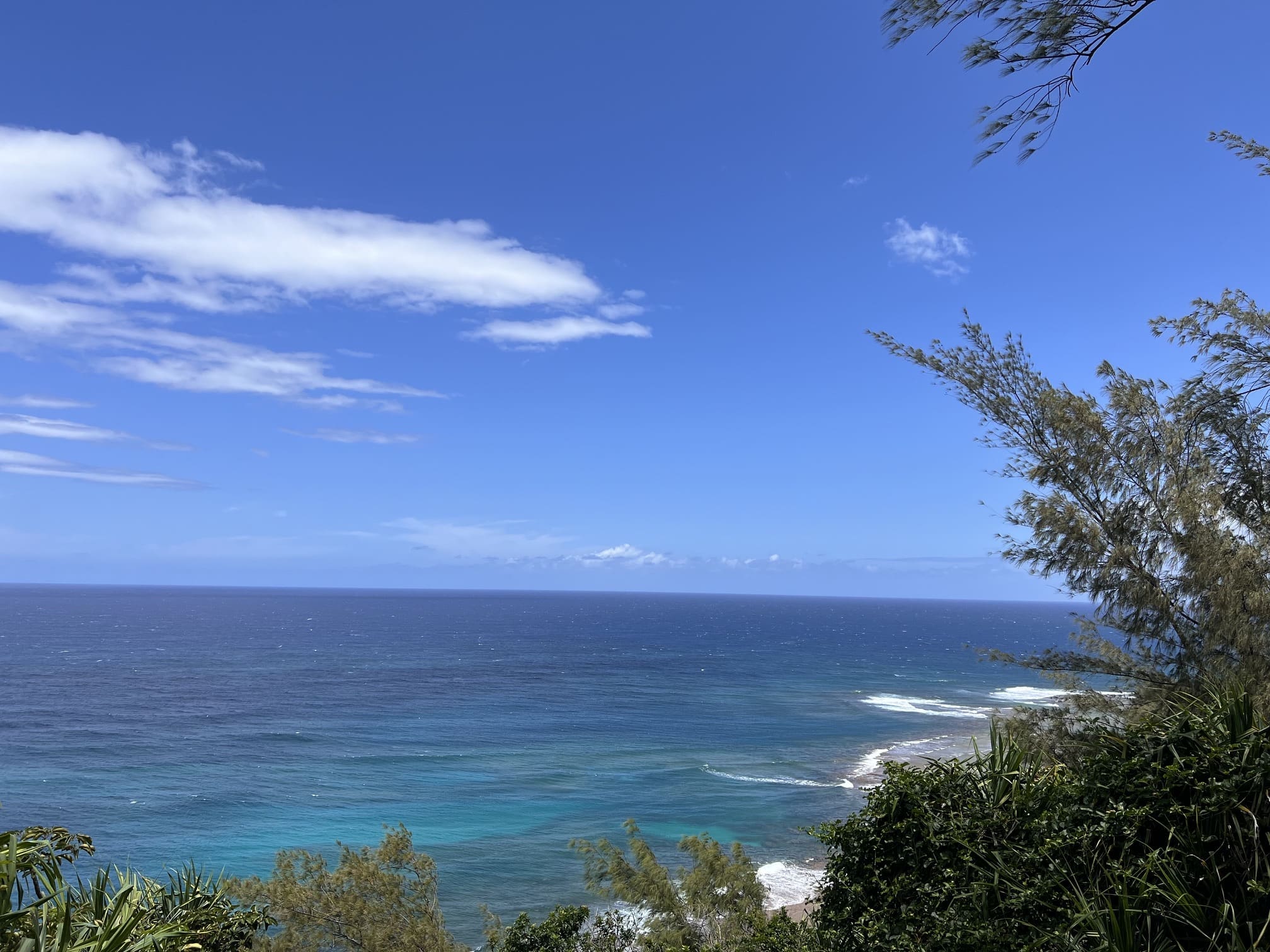
What to expect depends heavily on how far you plan to go and who you are traveling with. This is definitely not a Sunday stroll to a viewpoint. The payoff with the views is unreal, but the trail makes you work for it. What makes it even better though, is you don’t have to go all the way to get those incredible cliffside views of that beautiful blue water.
If you are hiking with kids or older family members, even the first half-mile up to the ocean viewpoint is a steep, rocky climb over exposed tree roots. It takes a solid twenty to thirty minutes of steady uphill walking just to get that first look at the coast. For casual day hikers, hitting Hanakāpīʻai Beach is a two-mile walk. If you choose to go even further, you can head another two miles inland along the stream trail to reach Hanakāpīʻai Falls. That makes it an eight-mile round trip that requires real stamina, solid hiking shoes, and trekking poles to navigate the slick descents and boulder-hopping stream crossings. If you are one of the experienced backpackers holding a camping permit to do the full eleven miles to the valley, the effort spikes dramatically after the beach, requiring you to cross narrow, crumbling ledges with a heavy pack.
Timing Your Day
No matter your destination, your timing relies on scoring an early morning shuttle reservation. Those 6:30 and 7:00 AM slots are incredibly hard to get, and they sell out almost the second they go live 30 days in advance. If you miss that window, your strategy changes. Driving yourself isn’t really an option either, unless you manage to score one of the rare, highly competitive park parking vouchers that sell out just as fast. The only exception is for Hawaii residents with a valid state ID, who can park on a first-come, first-served basis. Otherwise, a park attendant down the road will literally turn your car around. If you end up on a later shuttle slot, you might find yourself arriving closer to noon, looking up at the cliffs in the blazing midday sun, and realizing you have to scale back your plans for a shorter walk and more beach time.
But even if you do hit the trail a little later, or if the clouds roll in, the Nāpali ridges just take on a completely different look. Many hikers push to get an early start to catch clear weather before the afternoon mist or heat sets in, but looking out at the ocean from those high cliffs is memorable no matter what time you get there.
Know Your Limits
That is because the trail features sustained elevation gain and terrain that is slick and uneven in many sections, particularly on the descent. There is at least one downhill section where getting your footing is genuinely difficult, and the humidity is relentless. I actually turned around at just over a mile in while still rebuilding my fitness after cancer treatment, and it was absolutely the right call. I did not need to reach Hanakāpīʻai Beach for it to be a meaningful experience.
You have to assess your realistic fitness level, carry more water than you think you need, and give yourself permission to turn around the moment your body asks. The trail does not penalize you for stopping early. The views behind you are just as stunning as the ones ahead.
The best part about hiking first is the payoff at the end. By the time you get back down to the trail, your legs will be tired and your shoes will be dirty. After a few hours of sweating out on the trail, there is nothing better than dropping your pack and jumping straight into the cool, clear water at Kēʻē Beach to rinse off the dirt and sweat before boarding the shuttle back.
Distances & Times
| Destination | Distance | Estimated Time | Notes |
|---|---|---|---|
| Hanakāpīʻai Beach | 4 miles round trip | 3–4 hours | Main day hike destination |
| Hanakāpīʻai Falls | 8 miles round trip | 6–8 hours | Stream crossings; experienced hikers only |
| Hanakoa Valley | 12 miles round trip | 8+ hours | Mile 6, the usual overnight stop. Camping permit required beyond Hanakāpīʻai. |
| Kalalau Beach | 22 miles round trip | Full day each way | Mile 11, the trail’s end. Camping permit required, and day-hiking the full round trip is prohibited. |
Download the official trail map and brochure (PDF) from Hawaii DLNR
If You’re Camping: A Different Permit, A Different System
Everything above covers day visits. Camping on the Nāpali Coast runs on a separate track, and almost nothing about it works the way the day-use system does.
The window is ninety days, not thirty, and it’s a different website. Nāpali Coast camping permits are sold through the state reservation system at explore.ehawaii.gov, released at midnight Hawaiʻi time ninety days before your first night. Fees are $25 per person per night for Hawaiʻi residents and $35 for non-residents. You can also buy in person at a State Parks district office, though the booking system’s own FAQ still carries a note saying offices may not be open to the public, so call the Kauaʻi District Office at (808) 274-3444 first if that’s your plan.
Your camping permit is also your park entry. Show it at the Hāʻena entrance and you don’t need a separate GoHaena reservation on top of it. Overnight parking is still bought separately, and only campers holding valid permits can reserve it.
The permit says Kalalau, but it covers Hanakoa too. Hanakoa sits at mile 6, roughly halfway, in a hanging valley with no beach. It has a composting toilet and two roofed shelters, and it’s where people stop when weather, darkness or a heavy pack catches them out. No separate Hanakoa permit exists. The rule to know is that you can’t camp two nights running there. The park maximum is five nights, and afterward everyone listed on the permit waits thirty days before overnighting again.
If Kalalau is sold out, there’s a walk-in route. A block of peak-season permits, labeled Kalalau-Peak in the reservation system, is held back from online sale and issued only in person at the Kauaʻi State Parks Office in Līhuʻe, Tuesday through Thursday from 8 a.m. to 11 a.m., first come, first served. The state runs it May 20 through September 7, 2026. Create your account at explore.ehawaii.gov before you go, which speeds up the counter but is not a booking. This is a route for backpackers, not a way to add Hāʻena to today’s plans: the office is in Līhuʻe, roughly an hour and a half from the trailhead, and what you walk out with is a camping permit, not a day pass.
Check the closure dates before you book. The Kalalau Trail closes on scheduled dates each summer with no camping permitted. In 2026 those are June 1 to 4, July 20 to 23, and August 24 to 27. They appear only in the reservation system’s alert feed, not on the DLNR park notices page and not on GoHaena, so they’re easy to miss when you’re checking the usual places.
Kēʻē Beach
After heading back down the trail, we went left straight to Kēʻē Beach. It was exactly the reward it sounds like. Kēʻē sits at the literal end of Kauaʻi’s north coast road, and you cannot drive any further than this point.
The beach is protected by an outer reef that creates a calm, clear lagoon for swimming. The water is completely sandy underfoot, the visibility is excellent, and you can swim all the way out to the edge of the reef where the water deepens and opens up toward the open ocean. While we were floating, we spotted a sea turtle swimming right near us. It was one of those surreal moments where you just completely stop moving and stare, the perfect payoff before boarding the shuttle back.
Maniniholo Dry Cave
Right across the highway from Hāʻena State Park, near the return shuttle stop, is Maniniholo Dry Cave: a massive ancient sea cave you can walk straight into. No permit. No gear. No hiking required.
The inside is bigger than it looks from the road. The ceiling of the larger chamber is high enough to walk under, and the chamber goes back farther than expected. There’s no lighting inside, so let your eyes adjust as you make your way deeper into the cave. The good news is the ground is solid so you don’t have to worry about it falling out from under you.
There is a smaller chamber to the left once you get to the back. The ceiling is lower so please watch your head. It doesn’t feel too good to hit your head on that hard lava rock. Ask me how I know.
You can take as much or as little time as you would like here. We checked it out on the way back to the shuttle. Glad we gave ourselves extra time so we didn’t have to rush through.
Planning Your Day at Hāʻena
Which shuttle you take changes everything. It completely shapes your entire day at the park.
We had a later shuttle time and arrived at the park mid-afternoon with approximately four hours before we needed to be at the return shuttle stop. Four hours is workable, but it compresses everything. The Waipa shuttle runs every 20 minutes starting at 6:20 AM, with the last park pickup at 6:40 PM. Earlier is always better.
Shuttle Departure at a Glance
| Waipa Departure | Approx. Time on Site | Best For |
|---|---|---|
| 6:20–8:00 AM | 8+ hours | Serious hikers; full trail + beach + cave with room to breathe |
| 8:00–10:00 AM | 6–8 hours | Good balance; trail to 2+ miles + full beach time |
| 10:00 AM–12:00 PM | 4–6 hours | Beach-focused; abbreviated trail; still very worth it |
| 12:00 PM+ | 3–4 hours | Beach and cave only; trail time is very limited |
What We’d Do Differently
Book an earlier shuttle. The early slots were gone by the time we booked, so we turned the later departure into a Hanalei morning and finally made it to Hanalei Bread Company — which we’d tried the afternoon before and couldn’t get into. It worked out. But four hours at the park isn’t enough if you want to hike and swim. Book the earliest slot available; if you end up with a later one, a Hanalei morning is a genuinely good use of the wait.
Schedule time for the botanical garden. Right near the park is the Limahuli Garden, part of the National Tropical Botanical Garden system. We didn’t have enough time to include it, but it’s the kind of place that deserves its own unhurried visit.
Build extra return buffer. The return shuttle is first come, first served. We made our bus without issue, but we weren’t lingering. If you want to stay until the last possible moment at the beach, get to the stop 25–30 minutes before your target departure just in case a bus fills ahead of you.
Hāʻena Culture & Quirks Of The Law
Places like Hāʻena aren’t just beautiful vacation spots. They are deeply sacred cultural sites and heavily protected community lands. To make sure you’re respecting the island and staying on the right side of some very strict local laws, here are a few unwritten rules and legal quirks you need to know before you go.
Community Stewardship (Mālama ʻĀina)
The Community Model
The reservation system and shuttle weren’t built by a massive corporate entity. They were actually designed by North Shore residents through a local community nonprofit to protect the area from over-tourism and preserve the taro patches. Because of this, respecting the park staff and shuttle drivers means you are respecting the local community directly.
Trail Aloha
There is a strong culture of trail courtesy on Kauaʻi. It is custom to greet fellow hikers with a friendly hello as you pass each other. More importantly, the unwritten rule of the island is that downhill hikers always yield to the people who are grinding their way uphill.
Boot Brushing Protocol
At the main trailhead, you will see shoe-cleaning stations with stiff brushes. This isn’t just to keep your rental car clean. It is a vital practice to brush off the red clay so you don’t accidentally track invasive seeds or mud-borne diseases into pristine, isolated valleys.
Many waterfall pools are considered sacred.
In Native Hawaiian tradition, certain freshwater pools and streams hold deep cultural and spiritual significance. Enter with the same respect you would bring to any sacred site. Loud behavior, large groups, and disregard for the space are noticed — and felt.
Leave No Trace is not a suggestion.
Do not move rocks in or near stream beds. Do not pick plants. Do not feed wildlife. Do not cut switchbacks on trails. The ʻōpeʻapeʻa (Hawaiian hoary bat) and nēnē goose are protected species that inhabit waterfall areas — give them space.
No cliff jumping at state park waterfalls.
Jumping from rocks or cliffs into waterfall pools is prohibited at all Kauaʻi State Park locations. Depths change after rain and between seasons; submerged rocks are not visible from above. This rule exists because people have died here.
Legal Quirks
-
1
Every Beach is Public Space. By Hawaii state law, there are absolutely no private beaches on Kauaʻi. Landowners cannot block public access below the high-tide line. This means even the most exclusive resort-facing sand on the island is one hundred percent public space for everyone to enjoy. -
2
The Kapu Sign. You will frequently see signs that say “KAPU” posted on fences, trees, or near paths. In Hawaiian, kapu means forbidden, sacred, or prohibited. In both a legal and cultural context, it carries the weight of a strict no-trespassing law, often marking ancestral burial sites or family lands that should never be crossed. -
3
No Pets Allowed. A major quirk that catches people off guard is that pets are completely banned from all state parks on Kauaʻi. Even if a trail allows dogs elsewhere on the island, the state park boundaries restrict them entirely to protect native, endangered birds like the Nēnē goose. -
4
The Wildlife Bubble. It is a literal federal and state crime to get too close to marine wildlife. Law enforcement strictly enforces a mandatory buffer zone, meaning you must keep a distance of at least 10 feet from sea turtles and 50 feet from endangered monk seals. If a turtle swims toward you in the lagoon, the legal requirement is to remain completely still or gently float backward.
Don’t Make This Mistake
-
✕
Missing the permit window. The GoHaena system opens at midnight Hawaii time, exactly 30 days before your visit. All permit types release at the same moment. Popular dates sell out within the first 30 minutes. Set a calendar reminder, have your payment loaded, and be ready to book the second the window opens. Without a reservation, you cannot enter the park. There is no walk-up option. -
✕
Not checking conditions the morning of your visit. Hāʻena State Park can close with little notice due to weather, trail damage, or high surf. This is not a rare occurrence on Kauaʻi’s North Shore. Even with a valid permit in hand, the trail or shuttle may be suspended when you arrive. Check GoHaena.com/conditions the morning of your visit, not just the day you book. -
✕
Underestimating the trail. The Kalalau is officially rated very difficult, with constant steep ascents and descents starting right at the trailhead. That rating is accurate. Bring proper trail shoes with grip, significantly more water than you think you need, and zero ego about turning around. The views are extraordinary from the first 20 minutes. The full trail to Hanakāpīʻai Beach is 4 miles round trip (3–4 hours); the waterfall adds another 4 miles and stream crossings suited only for experienced hikers.
Other Common Pitfalls To Avoid
BSF Booking & Logistics Toolkit
🏷 Book Your Permit, Get the Map & Pack Right
▼
GoHaena.com: Reserve Shuttle & ParkingOfficial reservation platform for Hāʻena State Park. Book exactly 30 days out at midnight Hawaii time. Shuttle departs Waipa every 20 minutes, 6:20 AM to 6:40 PM last park pickup. Standby available on all departures.
GoHaena.com/conditions: Current Park StatusCheck this the morning of your visit. Trail closures, shuttle suspensions, and beach conditions are updated here first.
AllTrails: Kalalau TrailDownload the offline map before you leave your hotel. No cell signal at the trailhead. Recent reviews include on-the-ground conditions from other hikers.
Official Trail Map & Brochure (PDF): Hawaii DLNRPrint before you go. Includes trail distances, safety notes, and access rules. Useful backup when you have no signal.
Kauaʻi Lūʻau Guide: BSFCompare all 7 Kauaʻi lūʻaus by show style, schedule, menu, and package price. Includes our interactive finder.
Kauaʻi 5-Day Itinerary: BSFFull day-by-day guide covering helicopter routes, waterfalls, South Shore, and North Shore logistics.
South Shore Base Guide: BSFPoʻipū beaches, snorkeling, restaurants, and where to stay on Kauaʻi’s sunny south side.
Hāʻena State Park: Frequently Asked Questions
Hāʻena is one piece of Kauaʻi. We’ve built dedicated guides for the island’s waterfalls, the complete South Shore, and a full day-by-day itinerary.