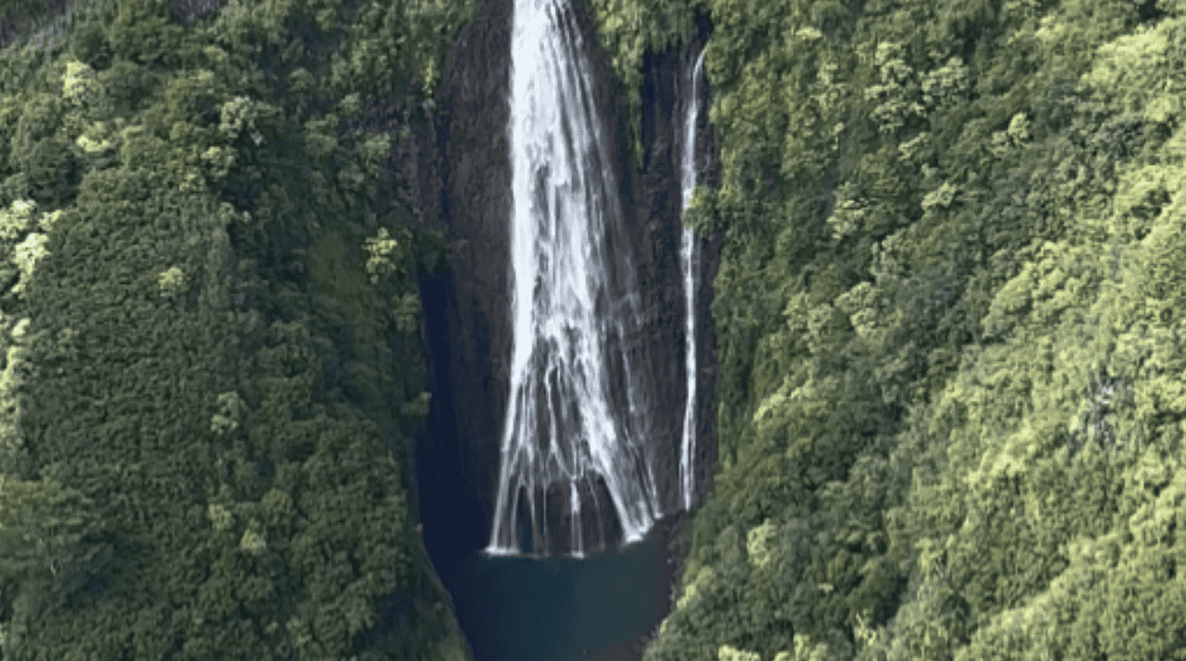
Kauai is one of the wettest places on earth. Mount Waialeale, anchoring the center of the island, receives an average of 450 inches of rain per year. The summit sees rain roughly 360 days a year, with a record 683 inches logged in 1982. That water has to go somewhere. It pours off ridges, slips through jungle canopies, and drops straight into the ocean along the Na Pali coast, feeding dozens of waterfalls that range from roadside pull-offs to helicopter-only legends deep in the island’s interior.
What makes Kauai’s waterfall scene interesting is the sheer range of access. Some of the island’s most beautiful cascades require nothing more than pulling your car over and looking left. Others demand a mile-long kayak paddle, a muddy stream crossing, and the willingness to soak your shoes. And the two most dramatic falls on the island have no road or trail leading anywhere near them. The only way to see them is by helicopter.
This guide breaks it all down by tier, starting at zero effort and working up to the legends you can only reach by air.
Best Season
Spring (Apr–Jun). Waterfalls are at full force from winter rainfall, and the jungle is at peak green. Summer has drier conditions; some smaller falls slow to a trickle.
After Rain
Every waterfall on this list intensifies dramatically after a heavy night of rain. The island’s best waterfall-chasing windows are the 24 hours following a big storm, so don’t cancel your plans because it rained.
Safety Note
Flash flooding is the primary danger. Waterfalls can surge from a trickle to a torrent in minutes when rainfall hits the mountains above, even if it’s sunny where you’re standing.
What to Bring
Water shoes for any swimming hole, a dry bag for your phone, insect repellent, a rain shell, and a credit card: state park fee kiosks do not take cash. Cell service drops to zero at most trail access points.
🍱 Local Words to Know
Wai – fresh water. You will see it everywhere in place names: Wailua, Waimea, Waipoʻo, Waialeale.
Mauka – toward the mountains. Weather forecasts and directions use it constantly; mauka rain is what floods waterfall streams.
Kapu – forbidden or sacred. A kapu sign is not a suggestion. If an area is marked kapu, stay out.
ʻŌpae – the native freshwater shrimp that gave ʻŌpaekaʻa Falls its name.
Waterfall Quick Reference
All waterfalls covered in this guide at a glance. Click any name to jump to its full card.
Disclosure: This post may contain affiliate links. If you book through them, I may earn a small commission at no additional cost to you. I only recommend experiences, accommodations, and services I’ve taken part in personally or researched thoroughly. See our
Privacy Policy for more details.
Timing Your Trip
Best Time to See Kauai’s Waterfalls
Waterfalls run on rainfall, so the calendar matters more here than it does for beaches. Every season on Kauai has flowing waterfalls; what changes is the volume, the trail conditions underfoot, and how often the weather lets a helicopter into the interior.
SPRING: THE SWEET SPOTSUMMER: DRY TRAILSFALL: VALUE WINDOWWINTER: MAX FLOW
Spring (April through June): The Waterfall Sweet Spot
Pros
- Winter rains have filled the watershed, so falls run full without winter’s daily downpours
- Trails firm up as the wet season tapers
- Best balance of flow and flyable helicopter weather
- Lighter crowds than summer at trailheads and kayak launches
Cons
- April can still throw wet weeks; keep waterfall days flexible
- Spring break crowds early in the window
We visited in early May and hit the version of Kauai the postcards promise: every major fall running hard, rainbows in the Wailua mist, and trail mud that was manageable instead of miserable. If waterfalls are the reason you’re coming, this is the window we would book again.
Summer (July through September): The Reliable Trail Season
Pros
- Driest trails and safest stream crossings of the year
- Most dependable weather for Secret Falls kayak days and Hanakāpīʻai
- Fewest helicopter weather cancellations
Cons
- Rain-fed falls thin out; Wailua Falls can drop to a single strand in a dry stretch
- Peak crowds: kayak tours and Hāʻena permits sell out fastest
- Waimea Canyon heat builds by late morning
Fall (October through November): The Value Window
Pros
- Crowds thin dramatically after Labor Day
- Trails stay in summer condition through most of October
- Early-season storms begin recharging the falls
Cons
- Flow is at its most unpredictable: strong after a storm, modest between them
- November starts tipping toward winter rain patterns
Winter (December through March): Maximum Flow, Maximum Caution
Pros
- The falls at their absolute biggest; roadside icons thunder
- Ephemeral falls appear on cliff faces that are dry the rest of the year
- Quietest trailheads of the year
Cons
- Flash-flood risk peaks; stream-crossing hikes need conservative go/no-go calls
- Muddiest trail conditions
- Most helicopter cancellations and rescheduled flights
Whatever season you land in, the single best waterfall-chasing window is the day after a heavy overnight storm, once the sky clears but before the watershed drains. Roadside falls double in volume, and short-lived cascades appear along the canyon rim. Check the forecast the night before and be willing to swap your itinerary days to chase it.
Tier 1
Zero-Effort Roadside Icons
These are the falls you drive to. Park the Jeep, walk 30 seconds to a paved overlook, and stare. They earned their reputations long before social media, and the payoff holds up in person.
As of February 22, 2026, Wailua Falls and ʻŌpaekaʻa Falls sit inside the Wailua River State Park fee system: $5 per person plus $10 per vehicle for non-Hawaii residents, paid at on-site kiosks, credit card only. Children 3 and under are free, and Hawaii residents with state ID pay nothing. The receipt works as a day pass across Wailua River State Park sites, so visit both falls (and Poliʻahu Heiau) the same day and you pay once. Verified July 21, 2026.
One of the most photographed waterfalls in Hawaii, and it earns the recognition. Wailua Falls thunders down in a wide twin cascade just past the roadside guardrail. You arrive, park, and you are already there. On a sunny morning, rainbows arc through the mist at the base like clockwork. The state sign says 80 feet; more than one survey has put the true drop closer to 173. Stand at the overlook and the taller number is easy to believe.
After heavy rainfall the volume is something else entirely, and the twin cascade can merge into a single curtain. Plenty of visitors come back two or three times in one trip to catch different light and water levels.
Wailua Falls faces eastward. Morning sun hits the falls directly before 10:30 AM, making the green foliage pop and creating the most reliable rainbow conditions in the mist. Arrive by 9:00 AM for the best light and the thinnest crowds.
Every year, visitors are injured attempting to scramble down to the base of Wailua Falls. The path off the guardrail is steep, overgrown, and genuinely slick even in dry conditions, and state park officials have posted clear warning signage for a reason. The overlook view is spectacular. You do not need the base shot badly enough to risk the descent, and you do not need the rescue bill either.
Wailua Falls is the waterfall from the opening credits of the 1970s TV show Fantasy Island. Online, though, it is sometimes mislabeled as “Jurassic Falls.” The actual Jurassic Park waterfall is
Manawaiopuna Falls, a completely different landmark deep in the Hanapepe Valley that you can only reach by helicopter.
ʻŌpaeka’a is actually taller than Wailua Falls (roughly 150 feet), but it sits across the valley from a dedicated scenic overlook with its own parking area. The name translates to “rolling shrimp,” a reference to the native Hawaiian ‘opae (freshwater shrimp) that historically gathered in the pool below.
It is at its most dramatic in the morning when the sun hits the falls directly. Pair this stop with the Wailua River kayaking launch (just down the road toward the ocean) to make it a full East Side waterfall morning. A pull-off on the opposite side of the road gives you a river and mountain backdrop in the same frame.
ʻŌpaekaʻa sits deep in a recessed valley. Shoot too early or too late and the surrounding cliffs cast heavy shadows that swallow the falls entirely. Full mid-day sun illuminates the whole canyon. This timing pairs perfectly with Wailua Falls. Do Wailua first at 9:00 AM for morning light, then swing here by 11:00 for the ideal window. See the driving loop below.
🚗 Driving Loop
The Seamless East Side Waterfall Loop
The two East Side roadside waterfalls have non-overlapping lighting windows, which means they’re built to be run back-to-back in a single morning. Bonus: they share the same state park day pass, so you pay the new entry fee once. The sequence:
1
8:00–8:45 AM: Leave your accommodation, timed to reach Wailua Falls by 9:00
Figure about 15 minutes from Lihue, 20 from Wailua, 30 from Kapaʻa, roughly 35 from Poʻipū, and about an hour from Kekaha, Princeville, or Hanalei. From Kuhio Hwy (Hwy 56), turn onto Maalo Road (Hwy 583), a short spur off the main highway, and follow it 2 miles to the Wailua Falls overlook.
2
9:00–9:30 AM: Wailua FallsMorning light hits the falls directly. This is your rainbow window. Pay at the kiosk, keep the receipt on your dash (it covers your next stop too), and allow 30 minutes at the overlook.
3
9:35 AM: Return to Kuhio Hwy, turn north toward Wailua
Cross the Wailua River bridge, then turn left onto Kuamoʻo Road (Hwy 580). Follow it 1 mile uphill.
4
9:45–11:15 AM: ʻŌpaekaʻa FallsThe canyon fills with light through the late morning and hits its ideal window right around 11:00 AM, so there is no need to rush this stop. Your Wailua Falls receipt covers it. Bonus: Poliʻahu Heiau, a preserved Hawaiian temple site, sits directly across the road and deserves a quiet, respectful visit.
+
Optional: Coffee, Shave Ice, or the Fern Grotto (11:15 AM)Both waterfalls are within a few miles of the Wailua strip, and Aloha Roastery is pouring by this time. For shave ice, JoJo’s is the one we go back to, and here is my unpopular opinion (my husband disagrees): order it without the macadamia ice cream scoop. The ice and syrup are the whole point. Wailua Shave Ice is also nearby; it’s still on our to-try list. The whole loop from first stop to coffee wrap-up runs about two and a half hours. Want to stretch it into a full Wailua day? Smith’s Fern Grotto river cruise departs from the marina downhill, and we compare it (and their famous garden luʻau) in our Kauai luʻau guide.
Tier 1 · West Side
Waimea Canyon: The Roadside Waterfall Drive
While the East Side has Wailua and ʻŌpaekaʻa, the drive up Waimea Canyon (Hwy 550) delivers a different waterfall experience: canyon-scale drama visible from roadside lookouts, and a small cascade so unexpected it makes you slow down and double-check what you just passed. All three can be ticked off in a single west-side morning, and one pass covers both Waimea Canyon and Kōkeʻe State Parks for the day.
Waipoʻo Falls is the centerpiece waterfall of Waimea Canyon: an 800-foot plunge off the canyon rim clearly visible from two pullouts on Hwy 550. Stop at Puʻu Ka Pele Lookout (Mile 12) or Puʻu Hinahina Lookout (Mile 13.5) and scan the opposite canyon wall. On a clear morning, Waipoʻo is unmistakable: a thin white vertical line cutting through deep red canyon walls and dense jungle. The scale of the canyon only makes the drop look more dramatic.
The Canyon Trail (2.8 miles round trip, trailhead off Hwy 550) takes you to the top of the falls, not the base. You stand above the 800-foot drop looking across the canyon, which offers a spectacular panoramic view, but you do not see the waterfall itself from trail’s end. The falls are below you. For the visual drama, the lookouts are the right call.
The canyon faces east and the morning sun illuminates the canyon walls, including Waipoʻo, most directly before 11:00 AM. Clouds move through the canyon constantly. Even if the falls are obscured on arrival, wait a few minutes; the view shifts fast. By early afternoon, the western walls cast heavy shadows across the falls and the full drama fades.
About ten minutes up the canyon drive from Waimea town, near mile marker 23, a small cascade appears on the left side of the road, pouring over a face of deeply saturated orange-red volcanic soil. No towering plunge, no thundering pool. Just clear water cutting through earth the color of rust. The red is the ground itself: iron-rich volcanic clay that saturates the whole hillside, rain or shine.
This one genuinely blew us away, and not because of its size. We simply never saw it coming.
Most drivers blow right past it. Stop. It takes two minutes, costs nothing, and the image looks like no other waterfall photo you’ll take on Kauai. Two cautions: the pullout is a narrow shoulder, so cross the road carefully, and that famous red clay is slick when wet and stains everything it touches. Wear shoes and clothes you don’t mind sacrificing.
From the main Waimea Canyon Lookout (Mile 10, Hwy 550), scan the far canyon wall with binoculars and you’ll find Waialae Falls: a 400+ foot freefall dropping to the canyon floor with no public trail to the base. The only up-close view is by helicopter. From the lookout it’s a rewarding find for anyone who brought binoculars. Look north-northwest from the main overlook platform.
Hwy 550 is a story road: every lookout, lava band, and side valley has history you’ll miss driving it cold. The Shaka Guide Kauai audio tour narrates the canyon drive turn by turn from your phone, works offline, and covers the rest of the island too.
→ GET THE SHAKA GUIDE AUDIO TOUR
Tier 2
Secret Roadside Guardrail Spots
These are not listed on most maps. They are the falls you find by driving slowly and watching the tree line: cascades that appear through the jungle canopy as you round a curve on a winding back road. No trailhead, no sign. Just a guardrail, the sound of rushing water, and a frame of deep green.
The best guardrail waterfall spots on Kauai are found on the Wailua River Road (Hwy 580) heading inland toward Keahua Arboretum, and on the back roads behind Princeville on the North Shore. Drive slowly, windows down. When you hear water and the canopy closes in overhead, start looking for a safe pullout. Many of these falls are visible only in the moment, and after heavy rainfall they appear where there was nothing the day before.
What makes these spots special isn’t the waterfall alone. It’s standing at the guardrail with the jungle closed in around you, the road quiet, and the feeling that you’re the only person who found this particular view. That sense of discovery is a big part of why Kauai gets under your skin.
Many of the backroads where these spots are found are one-lane and actively used by local drivers. Pull entirely off the road before stopping. Never block the lane, even briefly. On Kauai, these roads belong to the residents first; tourists are guests. Treat the road, and the locals who use it daily, accordingly.
Tier 3
Earned Adventure Treks
These falls require you to work. A kayak paddle, a muddy stream crossing, a permit, or a steep climb through jungle. The payoff is proportional to the effort.
First, flash floods: never enter or cross a stream that is murky, rising, or moving fast, and get to high ground if the water changes while you’re in it. Second, leptospirosis: Hawaii’s freshwater streams can carry lepto bacteria, which enter through cuts, eyes, nose, and mouth. Keep open cuts covered or out of the water, avoid submerging your head, never drink stream water, and skip swimming entirely for a few days after heavy storms when runoff is highest. Neither risk should scare you off these falls. Both should shape how you behave at them.
The name “Secret Falls” is something of a misnomer at this point. It is one of the most popular guided kayak-and-hike day trips on the island. But the setting genuinely earns the name. The journey takes you up the Wailua River by kayak (about 2 miles), then along a muddy 2-mile trail through dense jungle, crossing the same stream multiple times before arriving at a tall, narrow cascade that pours into a clear swimming pool completely hidden by a canopy of tropical trees.
You can do this self-guided (kayak rental from the river launch) or as part of a guided tour that includes equipment and a naturalist guide. The guided version is worth considering for first-timers: the trail is not well-marked, stream crossings are slippery, and conditions change rapidly after rain.
Book a guided kayak tour for this one if it’s your first time on the island. The trail beyond the kayak landing is not clearly signed, conditions deteriorate fast after rain, and having a guide who knows the stream crossings well turns a stressful scramble into one of the best mornings of your trip.
→ BOOK THE WAILUA RIVER & SECRET FALLS KAYAK TOUR
Confident paddlers and repeat visitors can run the same river on a stand-up paddleboard rental and hike in at their own pace. Same trail, same conditions caveats, more freedom over your clock.
→ RENT A STAND UP PADDLEBOARD TO SECRET FALLS
Hidden Valley Falls is the gentler paddle-to-waterfall day, and it runs on a completely different river. The Huleʻia is calm, protected water that winds past its namesake National Wildlife Refuge and through private ranch land near Lihue, the same stretch that stood in for the jungle rivers of Raiders of the Lost Ark and Jurassic Park. The paddle is about two miles with the wind at your back, and the hike beyond the landing is a short, fern-lined walk of roughly three-quarters of a mile each way.
The falls themselves are a cascading series of pool-drops over black lava rock rather than one tall plunge, with a rope swing over a deep mountain pool as the main event. Because the route crosses private land, access is by guided tour only, which keeps group sizes structured and the falls far less congested than Secret Falls on a busy day. The other luxury: you do not paddle back. Tours return you downriver in a motorized double-hulled canoe while you sit there dripping and pleased with yourself.
→ BOOK THE HIDDEN VALLEY FALLS KAYAK & HIKE
Secret Falls vs. Hidden Valley: Which Paddle Day?
Both are kayak-then-hike waterfall adventures, and that is where the similarity ends. Here is the honest head-to-head.
|
Secret Falls (Uluwehi) |
Hidden Valley Falls |
| River |
Wailua River, East Side |
Huleʻia River, South Side |
| Paddle |
~2 miles each way; the return often fights the afternoon headwind |
~2 miles downwind, one way; motorized canoe ride back |
| Hike |
~2 miles round trip, muddy, multiple stream crossings |
~1.5 miles round trip, shorter and tamer |
| The falls |
100–120-ft single plunge into a deep swimming pool |
Cascading pool-drops over lava rock, with a rope swing |
| Crowds |
Heavy; self-guided and group tours share the pool |
Guided-only on private land, so smaller and more structured |
| Book it if |
You want the classic big-plunge payoff and don’t mind company |
You want the easier day, the rope swing, or you’re bringing kids |
At approximately 300 feet, Hanakāpīʻai Falls is the tallest waterfall on Kauai you can stand at the base of, and you earn every foot of it. The route follows the Kalalau Trail from Ke’e Beach past Hanakāpīʻai Beach (mile 2), then turns inland and climbs steeply through dense jungle another 2 miles up the valley. The trail gains significant elevation, crosses Hanakāpīʻai Stream several times, and can be extremely muddy and slick after rain.
The falls drop into a wide grotto with a deep pool below. On a clear day, it is one of the most dramatic settings on the island.
I made it to Hanakāpīʻai Beach and roughly a mile past it before turning back. The trail beyond the beach climbs steeply with exposed cliffside sections and slick footing. I was rebuilding my strength after cancer treatment and this was absolutely the right decision. The views from the trail and beach are extraordinary. The falls are not the only reason to be on this trail.
Hā’ena State Park requires advance shuttle or parking reservations, booked exactly 30 days out at midnight Hawaii time, and they sell out. Our
Hāʻena State Park guide walks through the full permit and shuttle logistics. Beyond the logistics: Hanakāpīʻai Valley floods quickly and without warning, and flash floods have killed hikers here. Never cross the stream if the water is murky, fast-moving, or higher than knee height. When in doubt, the beach is your turnaround point. The falls are not worth your life.
Hoʻopiʻi Falls is the quiet one: a stream-side walk through dense, dripping jungle in the Kapahi neighborhood above Kapaʻa, following Kapaʻa Stream to two distinct cascades. Upper Hoʻopiʻi is the smaller, more tranquil drop, with the pool where locals have historically jumped. Lower Hoʻopiʻi is the bigger show: a 30-to-40-foot drop surrounded by dense jungle. The stream valley even appeared in the original 1993 Jurassic Park.
Here is the honest part most guides skip: there is no formally designated public trailhead here. The route crosses privately held kuleana land tied to generational Native Hawaiian families, and rising social-media traffic has pushed the surrounding community to its limit. In 2025, residents took their concerns to the Kauaʻi County Council, and new signage and enforcement have been in the works since. Some community members are asking visitors to hold off entirely until access is formally resolved. We think that request deserves real weight.
Due to the fragile ecosystem, the lack of official infrastructure, and the ongoing friction with the local residential community, we join many Kauai guides and local advocates in strongly discouraging treating Hoʻopiʻi Falls as a casual tourist hike.
Park only in the public lot at Kapahi Park and walk in; roadside and shoulder parking on these residential streets is exactly what escalated tensions with residents. Know the terrain before you commit: the trail sits low along the stream in a jungle valley, so heavy rain upstream can flash the crossings with very little warning, and the path is unpaved, frequently muddy and slick, with steep, root-heavy sections. Stay on the main streamside path, keep your group small and your voice down, pack out everything, and treat the stream as the sacred place it is. Do not cliff jump, even though you may see locals do it at the upper pool: depths shift after storms, submerged rocks are invisible from above, and people have been seriously hurt here. The water also carries the same leptospirosis risk as every Kauai stream. If anything feels unwelcome when you arrive, that is your answer for the day. Secret Falls and Makaleha deliver a similar payoff without the community strain.
Makaleha Falls sits deep inside the Makaleha Valley on the East Side: a multi-tiered jungle waterfall earned by a 3-mile round-trip trail that does not spare you. The route crosses the stream multiple times, requires scrambling over fallen logs, and passes through sections of dense rainforest where the canopy closes overhead and the trail becomes less of a trail and more of a general direction through wet vegetation. It is an unmaintained route, unmarked in most places, and you navigate by staying close to the stream and watching for the worn line of foot traffic.
The falls themselves are a series of cascading tiers rather than a single dramatic drop. Each tier pools before spilling to the next, with a cool, clear swimming hole below the final tier. Because the approach keeps out casual visitors, the falls are typically quiet even on high-traffic island days. This is a locals’ waterfall in the truest sense.
The multiple river crossings become genuinely dangerous after heavy rain. Makaleha Valley funnels a significant watershed, and water levels rise fast and without warning. If it has rained heavily in the 24 hours before your planned hike, choose a different day. Always check the
National Weather Service Kauai forecast and look at East Side interior rainfall totals, not just the coastal forecast.
Water shoes or trail runners that can handle wet crossings are non-negotiable. Sandals and flip-flops are a bad idea on the log scrambles. Bring trekking poles if you have them. The footing on the return (downhill, slick roots) is where most people struggle. Start early before afternoon rain builds in the East Side interior.
Tier 4
The Unreachable Legends
Some of Kauai’s most spectacular waterfalls exist in the deep interior of the island, locked behind cliffs, inside valley walls, and on the edge of an ancient crater that receives more rainfall per year than almost anywhere on earth. No trail reaches them and no kayak gets close. The only way to see them is to fly.
Known the world over as the waterfall from the original Jurassic Park: the shot where the helicopter carrying Dr. Grant and Dr. Sattler descends into Isla Nublar for the first time, passing a massive white cascade on the valley wall. That waterfall is Manawaiopuna, and it is just as striking in person.
The falls sit in a narrow valley in the Hanapepe watershed, accessible only by helicopter due to private land on all approaches. At roughly 400 feet, it is one of the tallest waterfalls on the island, and its sheer, remote setting means you will likely be hovering in front of it with no other aircraft in sight.
We hovered directly in front of this waterfall in a doors-off Hughes 500. The scale is genuinely overwhelming. The wall of mist off the base, the roar of the water audible even over the aircraft, and the sheer vertical drop of the valley around it. This is the moment during the helicopter flight where most people go completely quiet.
The falls sit on private land, and Island Helicopters holds the only permission to land at Manawaiopuna. Their Jurassic Falls Landing Adventure trades some air time for roughly 25 minutes on the ground at the base of the falls, and they book direct rather than through the big tour platforms.
→ SEE THE JURASSIC FALLS LANDING TOUREvery other operator gives you the hover. How to choose between the landing tour, doors-off flying, and the rest of the field is exactly what our
Kauai helicopter tour guide breaks down.
Mount Waialeale means “overflowing water” in Hawaiian, and when you fly into its crater, you immediately understand why. The interior walls are covered floor-to-ceiling in moss and ferns so dense they look painted on, and dozens of thin waterfalls pour continuously off the crater rim in every direction. It is less a single waterfall than an entire wall of cascading water, hence the nickname: The Weeping Wall.
Flying into this crater is one of the most extraordinary natural experiences I have ever had. You are surrounded on all sides by ancient, dripping green walls, the aircraft small against the scale of the amphitheater, and the constant hiss and roar of water falling from every surface. It gives you visceral, immediate context for why the island’s valleys look the way they do.
Two things have to line up. First, the route: not every Kauai helicopter tour includes the crater, and shorter flights skip the interior entirely, so confirm when booking that your itinerary flies toward Waialeale and the Blue Hole basin at its base. Second, the weather: the mountain is covered in cloud roughly 300 days per year, and even on crater-routed flights the pilot makes a real-time call on whether entry is safe that day. This is the nature of flying inside one of the wettest places on earth. Some visitors book a second flight to try again, which tells you what the experience is worth when conditions cooperate.
There is a way to reach the Blue Hole on foot, and it is one of the most dangerous unofficial treks on the island: roughly 10 miles up the Wailua drainage with no marked trail, navigating by streambed and instinct, through repeated river crossings, deep mud, and terrain that sits squarely in flash-flood territory. The area also carries deep cultural significance. Unless you are a highly experienced backcountry navigator traveling with someone who knows the drainage, see the Weeping Wall from the air.
For waterfall-focused flights, doors-off is the version we would book again. Glass mutes the two things that make these falls surreal in person: the sound and the mist. We flew doors-off over the interior valleys, and that flight remains one of the most extraordinary experiences of our trip.
→ BOOK THE 60-MINUTE DOORS-OFF FLIGHTPrefer doors on, want the landing tour, or wondering whether a fixed-wing airplane makes more sense at half the price? Our helicopter tour guide compares every operator we trust, and our helicopter vs. airplane comparison settles the aircraft question.
📷 Photography
Pro Camera Settings & Filters for Waterfalls
Waterfall photography rewards a little technical preparation. The difference between a flat snapshot and a shot that looks like a magazine cover comes down to three things: timing, filters, and shutter speed. This is the setup we shoot with.
⏱ Shutter Speed
1/4 – 1 second → silky, flowing water (the classic look)
1/1000 second → frozen droplets, freeze motion
The 1/4–1 sec range requires a tripod. In bright Hawaiian sun you will need an ND filter to get shutter speeds this long without overexposing.
🌡️ Aperture & ISO
f/8 – f/11 → maximizes sharpness across the full frame
ISO 100 → lowest noise, cleanest shadows
Keep ISO at 100 and let your ND filter and shutter speed do the exposure work. Raising ISO to compensate destroys shadow detail in jungle scenes.
🔀 Filters: CPL
A circular polarizer (CPL) eliminates the glare off wet rocks, leaves, and the water surface itself. Without it, tropical jungle waterfall shots look washed out and reflective. With it, the greens saturate and the water reads as clear. This is the single most impactful filter you can add.
Rotate the CPL until glare disappears, usually at 90° to the light source.
🔀 Filters: ND64
A 6-stop ND filter (ND64) reduces light entering the lens by 64x, letting you shoot at slow shutter speeds (1/4 to 2 seconds) in bright daylight. Essential for silky-water shots at Wailua Falls mid-morning when the sun is fully out.
Stack the CPL and ND64 together if you need both glare control and long exposure. Expect a slight color cast; correct it in post.
Any shutter speed below 1/60 second will show camera shake without a tripod. A lightweight travel tripod (carbon fiber, under 3 lbs) handles every shooting scenario in this guide. For phone shooters: a small GorillaPod clamped to a railing or rock gives you the stability you need for silky water at no extra weight.
Every waterfall on this list produces significant mist. At Wailua Falls and Uluwehi (Secret Falls) the mist is constant and reaches far beyond the immediate pool area. Pack your camera in a dry bag between shots and wipe the lens filter before each frame. A microfiber cloth in your pocket is more useful here than any other piece of kit.
The Per-Falls Photography Matrix
Same island, very different shots. Here is how we would approach each major fall.
| Waterfall |
Best Light |
Rainbow Odds |
Long Exposure |
Phone Verdict |
| Wailua Falls |
8–10 a.m. |
High: mist catches morning sun |
Yes: ND filter, railing as brace |
Excellent; use 1x, not zoom |
| ʻŌpaekaʻa Falls |
Midday, when sun clears the valley wall |
Low |
Distance shot: zoom lens over ND |
Good; expect a small subject |
| Waipoʻo Falls |
Morning, before canyon haze builds |
Low |
Telephoto compression beats slow shutter |
Good wide; weak zoomed |
| Red Dirt Waterfall |
Overcast or soft light |
None |
Best long-exposure close-up on the island |
Excellent; get low |
| Secret Falls |
Midday, under jungle canopy |
None |
Yes: ND, but pack light |
Good; bring a dry bag |
| Hanakāpīʻai Falls |
Late morning valley light |
Occasional in spray |
Only if the tripod earns its 8-mile carry |
Good; protect from spray |
| From the Helicopter |
Morning flights |
Frequent below the aircraft |
No: shutter 1/1000+, no filters |
Great; burst mode, strap secured |
Match the Falls to the Trip
Which Waterfall Is Right for You?
Ten waterfalls is not a to-do list; it’s a menu. Start with the trip you’re taking and the falls choose themselves.
First Trip, Tight Schedule
Run the East Side morning loop: Wailua Falls at opening light, then ʻŌpaekaʻa. Two icons, one fee receipt, done before lunch.
Traveling with Kids or Limited Mobility
Stay in Tier 1: every fall there is visible from a lookout or pullout. If the crew wants a paddle, the Hidden Valley Falls kayak is the gentlest water-to-waterfall day on the island.
You Want to Swim Under One
Uluwehi (Secret Falls) is the answer. The pool is the payoff for the paddle and the mud. Read the freshwater safety rules first.
Serious Hikers
Hanakāpīʻai Falls is the marquee earn: 8 miles round trip, stream crossings, and a 300-foot amphitheater at the end. Permits 30 days out, no exceptions.
Photographers First
Wailua Falls in the 8–10 a.m. rainbow window, then Waipoʻo from the Puʻu Hinahina lookout. The per-falls matrix above has the settings.
Once-in-a-Lifetime Moment
The doors-off helicopter over Manawaiopuna and, if the clouds allow, the Waialeale crater walls. Nothing on the ground compares, and we say that as people who love the trails.
Crowd Allergic
Makaleha sees a fraction of the traffic, for a reason: unmaintained route, real navigation, real mud. Go in prepared or pick the quiet early window at a Tier 1 fall instead.
Rain Just Wrecked Your Beach Day
Perfect. Wait out the cell, then drive to Wailua Falls or the canyon rim. Storm-fed flow is the best show on the island, from a safe roadside distance.
Where We Stayed
Our Waterfall Basecamp: Koloa Landing Resort
Kauai’s waterfalls refuse to cluster. The roadside icons sit on the East Side, the canyon falls are far west, and Hanakāpīʻai anchors the North Shore. You cannot sleep next to all of them, so the smarter question is which base lets you run each waterfall day cleanly and come home to something worth coming home to. For us, that was Koloa Landing Resort in Poʻipū on the South Shore, and it’s where we based this entire trip.
The South Shore position works like a hinge for waterfall chasing. The East Side loop (Wailua and ʻŌpaekaʻa) is about a 35-minute morning drive, the Waimea Canyon lookouts are roughly an hour up the west side, and Lihue’s helicopter pads sit closer to Poʻipū than to the North Shore resorts. The one long day is Hanakāpīʻai, and that day starts before sunrise no matter where you sleep on this island.
What made it the right waterfall basecamp for us, though, is what happens after the trail. The suites are villa-style with full kitchens and, critically, a washer and dryer in the unit. Kauai’s red dirt does not come out of anything on its own; being able to strip off Makaleha mud and run a load before dinner is worth more than any lobby amenity. Then there’s the lagoon-style main pool, which is the point where a waterfall morning turns into a resort afternoon without getting back in the car.
→ CHECK AVAILABILITY AT KOLOA LANDING
Planning to explore beyond the waterfalls? Our
South Shore base guide covers the beaches, trails, and food within ten minutes of the resort.
Rewind & Reset
What We Would Do Differently
We went into our Kauai waterfall days without a real game plan, and it cost us better light and at least one waterfall. If we went back tomorrow, two things would change.
- Build the days around the tier system. Wailua Falls and ʻŌpaekaʻa Falls have non-overlapping light windows and are less than 10 minutes apart; they belong in a single tight morning loop. We did them out of sequence with a gap in between and didn’t get the best light at both. The West Side roadside falls work the same way: one morning, Waipoʻo and Red Dirt back-to-back, done before noon.
- Arrive trail-ready for Hanakāpīʻai. Turning around on the Kalalau Trail was the right call for that day, and we stand by it. But more trail miles in the months before the trip would have moved that decision point deeper into the valley. Next time, we train for that specific hike before leaving home, not after arriving and seeing what it asks.
Know Kauai
Kauai Waterfall Culture & Quirks Of The Law
Kauai’s waterfall and park culture comes with a few rules that are easy to miss if you don’t know to look for them. Most apply island-wide, and they matter more at waterfalls than almost anywhere else because so many of these places are culturally significant.
Many waterfall pools are considered sacred.
In Native Hawaiian tradition, certain freshwater pools and streams hold deep cultural and spiritual significance. Enter with the same respect you would bring to any sacred site: quiet voices, small groups, and care for the space.
Leave No Trace is not a suggestion.
Do not move rocks in or near stream beds. Do not pick plants. Do not cut switchbacks on trails. Pack out everything you carried in, including fruit peels; nothing decomposes fast enough in a place this visited.
“It’s just a little scramble” is how people get airlifted out.
The descent to the base of Wailua Falls is explicitly prohibited and genuinely dangerous: the slope is steep, overgrown, and slick even in dry conditions, and state park officials have posted clear signage. The overlook view is spectacular. The base view is not worth a helicopter rescue.
No cliff jumping at state park waterfalls.
Jumping from rocks or cliffs into waterfall pools is prohibited at all Kauai State Park locations. Depths change after rain and between seasons; submerged rocks are not visible from above. This rule exists because people have died here.
⚖️ Kauai Waterfall & Park Rules to Know
- 1.Hāʻena State Park requires advance permits. Access to Keʻe Beach, the Kalalau Trail, and Hanakāpīʻai Falls is restricted to permit holders only. Book at GoHaena.com exactly 30 days before arrival, at midnight Hawaii time. Our Hāʻena State Park guide walks through the whole reservation process.
- 2.Kauai County single-use plastic ban. Retailers and restaurants countywide cannot hand out single-use plastic bags, and the penalties land on the businesses: escalating fines that start at $250 per day and climb to $1,000. You won’t be fined as a visitor; you just won’t be offered plastic, so bring a reusable bag and water bottle.
- 3.No swimming after flash flood warnings. Swimming in or near any waterfall during or after a flash flood warning is illegal in active emergency conditions. When water is murky or rising, get out and move to high ground.
- 4.Stay on designated trails in state parks. Off-trail travel is prohibited in all Kauai State Park land. This includes “shortcut” paths between switchbacks. Violations carry fines.
- 5.No fires, camping, or overnight use without permits. Day use only at all waterfall access areas in this guide except permitted backcountry Kalalau camping.
- 6.Protected species live around these falls. The nēnē goose and the ʻōpeʻapeʻa (Hawaiian hoary bat) are protected under state and federal law. Feeding, approaching, or harassing them is illegal; if one is near the trail or pool, give it space and move on.
Heads-Up
Don’t Make This Mistake
These are firsthand mistakes we actually made on this trip that cost us time, access, or a better experience.
1Wearing sandals or open-toe shoes on waterfall trails.Waterfall trails are not beach walks. Waterproof open-toe shoes fail on trail roots, wet rock, and stream crossings. You need closed-toe grip shoes for any trail waterfall. Bring two pairs and leave the beach shoes in the car.
2Not checking how to actually get there before building your day around it.Half the waterfalls on this list require a kayak, a multi-mile trail hike, or a helicopter. Pull up the Quick Reference table the night before; access type determines everything about how you plan the day.
3Not downloading offline maps before leaving the hotel.Cell service at most Kauai waterfall trailheads is zero. If you have not downloaded AllTrails offline before you leave, you are navigating by instinct on unmarked jungle trails. Download at your hotel the night before.
4Arriving at Wailua Falls after 10:30 AM.The rainbow at Wailua forms in direct morning sun. By late morning the angle shifts and by midday the rainbow is gone. The light also flattens and the crowds build. Morning-only for this one.
Know Before You Go
Other Common Pitfalls To Avoid
These are the practical things that catch first-time visitors off guard, and they vary in how badly. A few will genuinely derail your day if you’re not prepared. The rest just create stress you don’t need. All of them are easy to sidestep once you know.
✕Not checking weather before heading to trail waterfalls.Flash flooding is the primary danger at every trail-access waterfall on this list. Check the National Weather Service Kauai forecast, interior mountain rainfall and not just the coastal report, the morning of your hike.
✕Underestimating what the Secret Falls kayak actually involves.The river paddle is two miles each way in open water, and the return leg is the part nobody budgets for: it often runs into the afternoon headwind after you are already tired and muddy. The trail beyond the landing is unmarked, muddy, and involves several stream crossings. First-timers almost always say the guided version was the right call.
✕Thinking overcast means bad waterfall conditions.Diffuse light actually makes waterfall photography easier: no harsh shadows, no blown-out highlights in the mist, and the jungle greens saturate beautifully. Overcast is fine. The only deal-breaker is active rain and rising water at the trailhead.
✕Forgetting a dry bag for electronics.Every waterfall on this list produces mist. At Wailua and Secret Falls, the mist is constant and reaches well beyond the pool. Phones die here. A $15 dry bag is the highest-ROI item in your pack.
✕Assuming you can pay park fees in cash.It’s the opposite: the fee kiosks at Waimea Canyon, Kōkeʻe, and the Wailua River State Park sites are credit card only, no cash. Fees run $5 per person plus $10 per vehicle for non-residents at each park system, so budget for both charges and keep a card handy.
✕Trying to see every waterfall in one trip.Ten waterfalls sounds like a checklist, but the earned falls, especially Hanakāpīʻai, Hoʻopiʻi, and Makaleha, need more time and energy than a full itinerary allows if you are also doing beaches, the South Shore, and the North Shore. Pick your tiers, run them well, and save the rest for the return trip.
Reassurances & Nuances
Kauai Waterfalls: Frequently Asked Questions
What is the best waterfall on Kauai? +
It depends on what you’re after. For zero-effort iconic beauty, Wailua Falls is the most photogenic drive-to waterfall on the island. For an earned jungle experience, Uluwehi (Secret Falls) delivers something completely different: a hidden pool at the end of a kayak paddle and a muddy trail most visitors never attempt. For once-in-a-lifetime, Manawaiopuna Falls from a doors-off helicopter is in a category of its own. The honest answer: plan for all three across different days.
Can you swim at Kauai waterfalls? +
Several, yes. Uluwehi (Secret Falls) has a clear, deep pool at the base; swimming is the point of the trip. Hoʻopiʻi Falls has a natural swimming hole at the lower tier. Wailua Falls has a pool at the base, but the descent involves an unsanctioned scramble that state park officials have explicitly warned against.
Always check conditions after rain. A calm pool can run fast and cold within hours of a mountain storm, and turbid or rising water is your signal to stay out. One more freshwater rule: Hawaii streams can carry leptospirosis bacteria, so keep cuts covered, avoid dunking your head, and skip swims for a few days after big storms.
When are Kauai waterfalls at their most spectacular? +
Spring (April through June) delivers peak activity. Winter rains fill the watershed to capacity, and by April the jungle is at its most intensely green while crowds are still thin. Summer brings drier conditions and some smaller falls slow significantly.
That said, Kauai’s major waterfalls run year-round, and the 24 hours following a heavy overnight storm are often the best waterfall-chasing windows of the year, even in the dry season.
Do I need permits to visit Kauai waterfalls? +
Most waterfalls in this guide require no permit. The key exception is Hanakāpīʻai Falls, accessed via the Kalalau Trail inside Hāʻena State Park: book exactly 30 days before your visit at GoHaena.com, at midnight Hawaii time, and expect it to sell out in hours.
No permits are needed for Wailua Falls, ʻŌpaekaʻa Falls, Waipoʻo Falls, Red Dirt Waterfall, or Secret Falls (which needs a kayak, not a permit). Since February 2026, though, Wailua Falls and ʻŌpaekaʻa charge non-resident entry and parking fees, as do Waimea Canyon and Kōkeʻe. Hoʻopiʻi has no permit system, but its access crosses private land and is actively contested; see its card above before deciding to go.
Is flash flooding a real risk at Kauai waterfalls? +
Yes. It is the primary safety concern at every trail-access waterfall on this list. Waterfalls can surge from a trickle to a dangerous torrent within minutes of rain hitting the mountains above, even when the sky above you is clear.
Before any waterfall hike, check the National Weather Service Kauai forecast for interior mountain rainfall, not just the coastal report. Never cross a stream that is murky, moving fast, or above knee height.
How do I get to Secret Falls (Uluwehi)? +
From the Wailua River launch on Kuhio Hwy (Hwy 56), paddle approximately 2 miles upriver, then hike a 2-mile jungle trail with multiple stream crossings. You can self-guide with a kayak or stand up paddleboard rental from the Wailua River launch, or book a guided tour. We recommend the guided version for first-timers: the jungle trail beyond the kayak landing is unmarked, muddy, and involves multiple stream crossings that change after rain.
Can I see Manawaiopuna Falls (Jurassic Park Falls)? +
Only by helicopter. Manawaiopuna Falls sits deep in the Hanapepe Valley interior and there is no road, trail, or permitted path to reach it on foot. Every helicopter tour operator on Kauai flies past it, and most include a hover or orbit above the falls. It is 400 feet tall and famously appeared as the arrival scene in Jurassic Park.
Book your helicopter tour well in advance; flights fill weeks out in peak season. Full-island routes typically cover Manawaiopuna, the Na Pali coast, and Waimea Canyon in a single flight, and Island Helicopters runs the only tour permitted to land at the base. Our helicopter tour guide compares the operators.
Which waterfalls can I see in one day if I’m staying in Poʻipū? +
More than you’d think. From Poʻipū you can run the East Side morning loop (Wailua Falls and ʻŌpaekaʻa, about 35 minutes each way) and still have your afternoon, or head the other direction and stack Red Dirt Waterfall, the Waipoʻo lookouts, and Waialae Falls on one Waimea Canyon drive. Helicopter departures from Lihue are roughly 30 minutes away. The only waterfall day that genuinely strains a Poʻipū base is Hanakāpīʻai on the North Shore, and that day starts before sunrise wherever you’re staying.
Inspired by This Guide?
You’ve seen how I’d chase waterfalls on Kauai. Now, how should we plan your waterfall days?
A great waterfall day on Kauai comes down to sequencing: light windows, drive order, fee stops, permit deadlines, and a weather call you make that morning. That’s the planning I do for clients, matched to your pace, your group, and how much mud you actually want.
Choose Trip Design if you want the full plan and prefer to book it yourself, or Dream to Done if you want every reservation handled start to finish.
Start Your Trip Design Inquiry
Explore Dream to Done